 fuyuhuaxue@iumrs.com
In a hospital, the most critical surface is often the one no one looks at. It is the floor beneath the gurney racing toward the operating room, the surface under the nurses’ station where a spilled cup of coffee is wiped up between shifts, the corridor outside the ICU where a patient’s family paces at midnight. In a commercial kitchen, the floor is equally thankless: it absorbs the slip of a dropped knife, the splatter of hot oil, the daily assault of industrial degreasers and sanitizers. In both environments, the floor is not merely a walking surface. It is a frontline defense in infection control, a silent contributor to food safety, and a daily visual statement about the standards of the institution.
For decades, the default answer to these demands was tile and grout—a system that looks clean in a showroom but reveals its weaknesses under real-world conditions. Grout lines are porous. They absorb liquids, harbor bacteria, and resist thorough disinfection. Seams between tiles lift and crack. Vinyl flooring welds fail. Even polished concrete, for all its hardness, is not inherently hygienic; it stains, dusts, and requires sealing that wears away. Every joint, every seam, every porous pocket is an invitation for pathogens and a hidden cost in maintenance labor.
The industry has been moving steadily toward a different solution: seamless resinous flooring, specifically self-leveling epoxy systems that cure into a non-porous, monolithic surface. Among these, the hygienic epoxy floor with a self-leveling stone effect—formulated with colored float sand and engineered for bacteria resistance—has emerged as a particularly compelling answer for hospitals, clinics, commercial kitchens, and food processing facilities. It combines the mechanical toughness of a 100% solids epoxy with an aesthetic that feels less clinical than traditional resin floors, and a hygiene profile that directly addresses the vulnerabilities of conventional materials.
The Anatomy of a Hygienic Floor
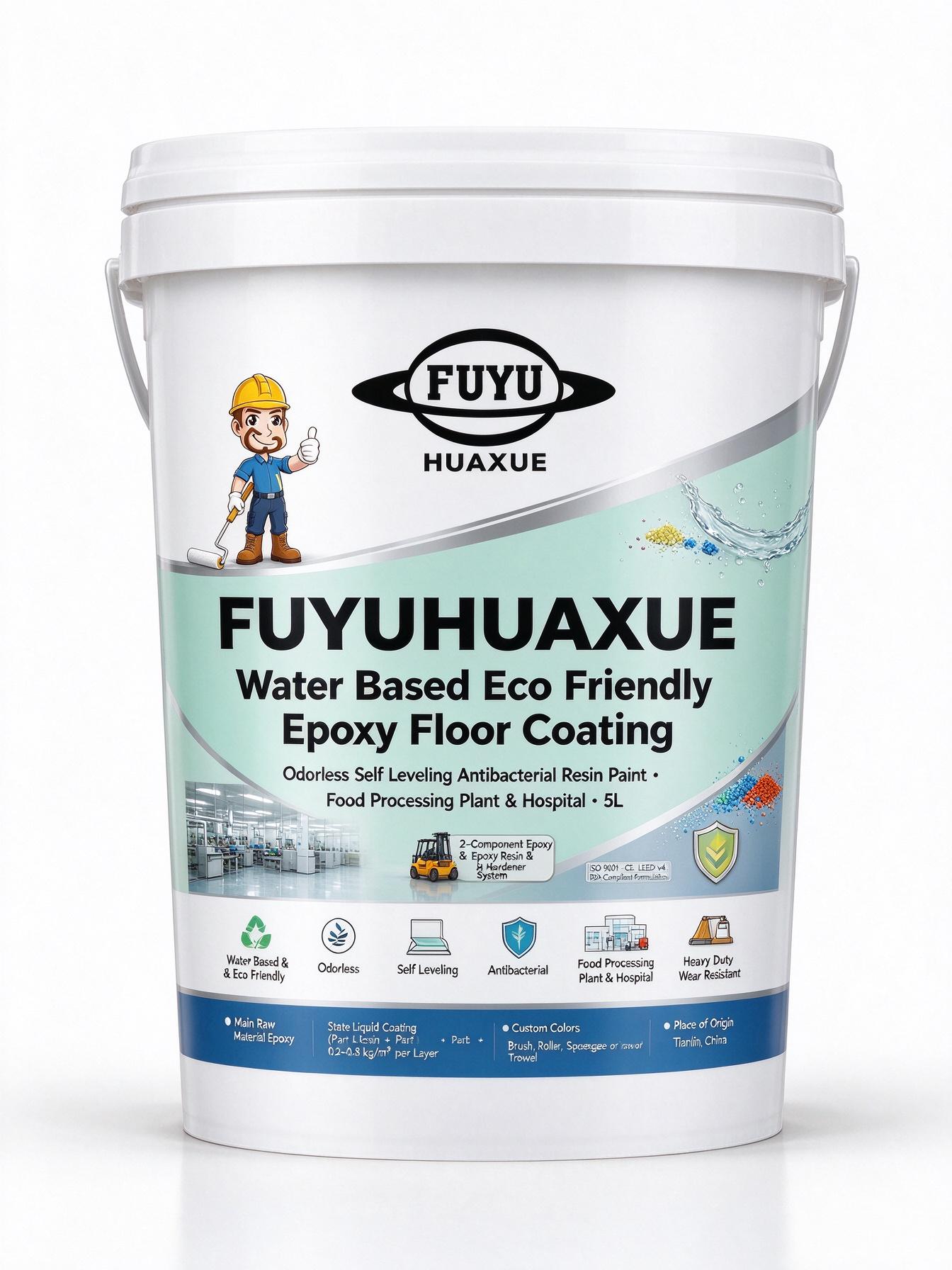
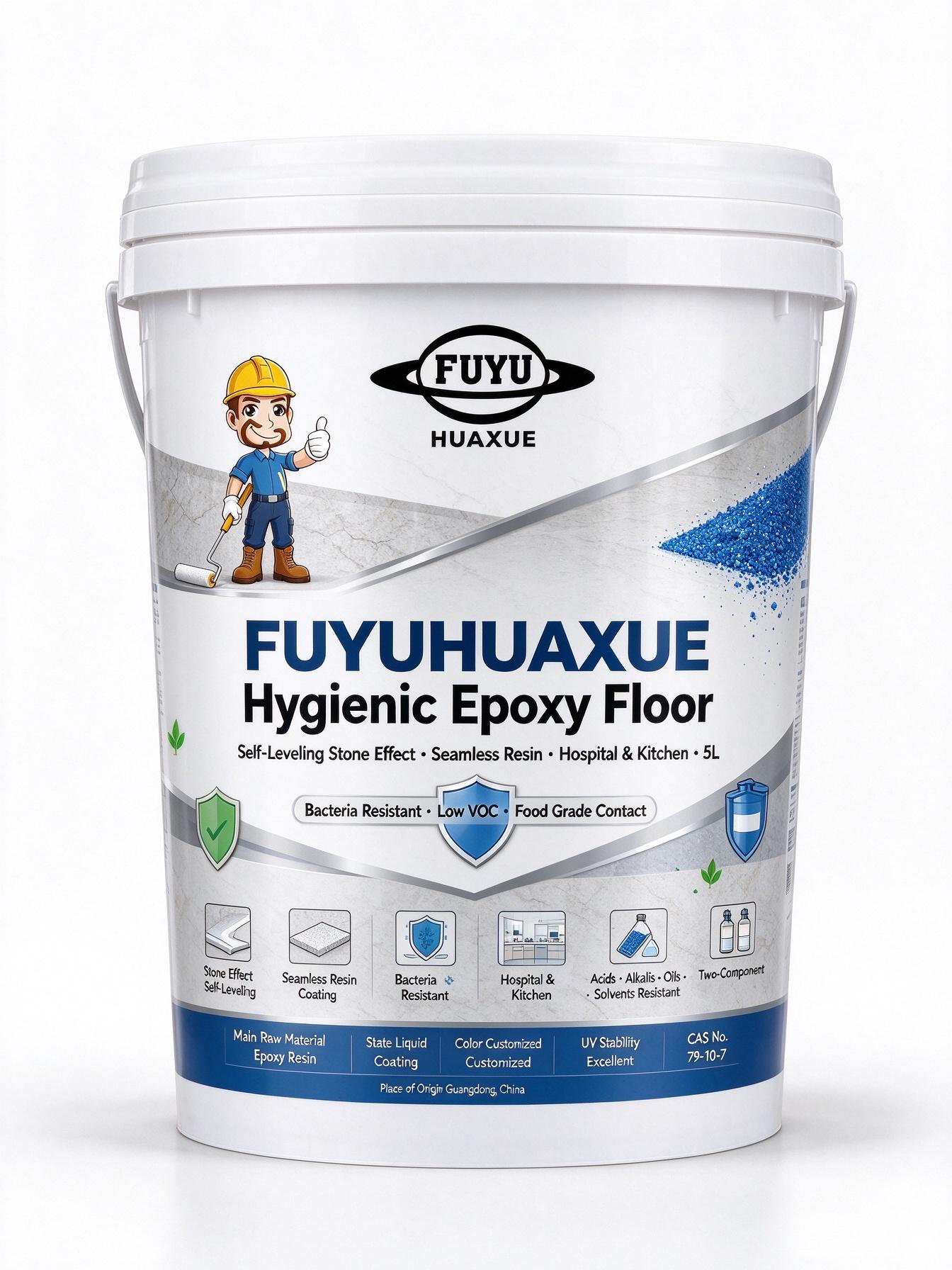
At the heart of this system is a two-component epoxy chemistry: a resin and a curing agent, combined with colored float sand to create the decorative stone effect. The product, marketed by Guangdong-based manufacturer FUYUHUAXUE as an epoxy colored sand self-leveling coating, is a liquid-applied system that cures in place. Once mixed and poured, it self-levels to a smooth, seamless finish, flowing into minor irregularities and creating a continuous membrane across the entire floor area. For edges, corners, and details, the material is applied by brush, ensuring that the hygienic barrier is unbroken from wall to wall—no gaps, no seams, no weak points where bacteria can settle.
The chemistry also carries important certifications and attributes. The formulation references CAS No. 79-10-7 (a raw material component) and is classified under EINECS as a mixture. Its main raw material is epoxy resin, and the cured film is engineered to resist dilute acids, alkalis, oils, and solvents—a critical performance requirement in both healthcare and food service. In a hospital, that means the floor can withstand the repeated application of hospital-grade disinfectants, including chlorine-based and quaternary ammonium compounds, without degrading or discoloring. In a kitchen, it resists the fatty acids and cleaning chemicals that break down lesser coatings.
Perhaps most importantly for sensitive environments, the system is formulated to be eco-friendly and low in volatile organic compounds (VOC). This matters during installation and beyond. Hospitals cannot shut down entire wings for a week; schools and kitchens cannot afford prolonged downtime. A low-odor, low-VOC system allows work to proceed in occupied or adjacent spaces with minimal disruption, and it contributes to healthier indoor air quality—a growing concern in facilities where patients, children, or food are present. The product also carries a food-grade contact rating, making it suitable for areas where direct contact with food is possible, such as commercial kitchens, food preparation zones, and storage areas.
Why Bacteria Resistance Is a Flooring Issue
Bacteria do not respect the visual cleanliness of a floor. They colonize in the microscopic crevices of grout, in the seams of vinyl welds, and in the porous surface of untreated concrete. Once established, biofilms can be extraordinarily difficult to remove, and they can persist even after routine cleaning. In healthcare settings, where healthcare-associated infections (HAIs) are a persistent concern, the floor is increasingly recognized as part of the transmission chain—not necessarily as a primary source, but as a reservoir that can be disturbed by foot traffic, wheeled equipment, and cleaning procedures.
A seamless, non-porous epoxy floor eliminates that reservoir. There are no grout lines to scrub with a toothbrush. There are no seams to harbor moisture. The surface is chemically resistant and can be cleaned and disinfected with standard protocols using mops and mechanical scrubbers. Because the finish is monolithic, there is no differential wear between materials—no edges where dirt collects, no cracks where bacteria can hide. The result is a floor that is not only easier to clean but also easier to verify as clean, which is a meaningful distinction in accreditation audits and food safety inspections.
The Stone Effect: Hygiene Without the Clinical Chill
One of the historical drawbacks of seamless resin flooring was its appearance. Early epoxy floors were often monolithic, high-gloss, and institutionally cold—perfectly functional, but not particularly welcoming. The self-leveling stone effect changes that equation. By broadcasting colored float sand into the epoxy matrix, manufacturers create a surface with depth, subtle pattern variation, and a natural stone-like appearance. The effect is decorative without being distracting, and it serves a practical purpose as well: the mottled pattern masks scuffs, tire marks, and the everyday soil that shows up starkly on a solid-color floor.
For hospitals, this means corridors and patient areas can be hygienic and visually calming at the same time. Color can be customized to support wayfinding—a subtle blue for one wing, a warm sand tone for another—without relying on signage alone. For commercial kitchens, the stone effect provides a clean, professional look that stands up to grease and moisture, and the customizable color options allow the floor to coordinate with brand standards or simply to create a brighter, more pleasant workspace for staff. FUYUHUAXUE offers OEM and ODM services, meaning specifiers and distributors can tailor the color, packaging, and branding to their specific project requirements.
Chemical Resistance: The Hidden Workhorse
Hospitals and kitchens share a common adversary: aggressive cleaning chemicals. In healthcare, floors are routinely exposed to sodium hypochlorite, hydrogen peroxide, quaternary ammonium compounds, and enzymatic cleaners. In kitchens, the threats include hot water, degreasers, citric acid-based sanitizers, and the natural acidity of food spills. A flooring system that cannot resist these substances will degrade—first losing its sheen, then its protective layer, and eventually its structural integrity.
The epoxy system from FUYUHUAXUE is formulated to resist dilute acids, alkalis, oils, and solvents, providing a durable barrier that maintains its performance under repeated chemical exposure. This resistance is not merely a matter of convenience; it is a matter of safety. A degraded floor can become slippery, porous, or prone to cracking, creating slip hazards and hygiene risks. By maintaining its chemical integrity, the floor continues to perform its primary functions—protecting the substrate, supporting cleanliness, and providing a safe walking surface—throughout its service life.
UV Stability and Long-Term Aesthetics
Another attribute that distinguishes high-quality epoxy systems is UV stability. Many epoxy floors yellow over time when exposed to sunlight, which is a particular concern in corridors with large windows, atriums, or glass-walled kitchens. The FUYUHUAXUE formulation is engineered for excellent UV stability, meaning the color remains true and the stone effect retains its visual appeal even in daylit spaces. This is not just an aesthetic concern; in hospitals, consistent color supports wayfinding and a sense of order, while in kitchens, a floor that stays visually clean reinforces staff morale and customer confidence in open-kitchen concepts.
Application and Practicality
The product is supplied as a two-component system, with a single package size of 30×30×37 cm and a gross weight of 25.0 kg—a practical format for contractors and facility maintenance teams. The application method combines self-leveling for the main floor area with brush application for edges and details, ensuring a continuous membrane without the need for complex cove forming or seam welding. The liquid coating cures to a hard, seamless surface that is ready for traffic within a predictable timeframe, minimizing downtime for the facility.
For specifiers, the availability of OEM and ODM services means the product can be adapted to local market requirements, including custom colors, private labeling, and packaging specifications. The Guangdong origin and FUYUHUAXUE brand name provide a traceable supply chain, which is increasingly important for institutional procurement teams who need to verify material sourcing and quality control.
The Bottom Line for Hospitals and Kitchens
The decision to specify a hygienic epoxy floor is not merely a flooring choice. It is an infection-control decision, a food-safety decision, a maintenance-budget decision, and a patient-experience or customer-experience decision. In hospitals, the floor is part of the healing environment; in kitchens, it is part of the food safety system. In both, it is a surface that must perform every hour of every day, under chemical attack, mechanical stress, and the constant scrutiny of cleaning protocols and inspection audits.
FUYUHUAXUE’s self-leveling stone-effect epoxy floor addresses these demands with a combination of attributes that is difficult to match: a seamless, non-porous surface that resists bacteria; chemical resistance to the disinfectants and degreasers that define institutional cleaning; low VOC and food-grade contact suitability; UV stability for long-term aesthetics; and a customizable stone effect that brings warmth and professionalism to spaces that are often designed for function alone. It is, in essence, an invisible shield—one that protects patients, staff, food, and the bottom line, while looking good enough that no one ever thinks about the floor beneath their feet. And that, for a hygienic floor, is the highest compliment of all.