 fuyuhuaxue@iumrs.com
Walk down any hospital corridor at 7 a.m., and the floor is already working. Gurneys roll over it. Disinfectant carts trail it. Staff shoes pivot on it. By mid-morning, a school corridor takes over: hundreds of students, wet boots, dropped lunch trays, the occasional scuff that no one reports until a parent tour. An office corridor is quieter but no less demanding—ten thousand footsteps a day, coffee spills, the silent abrasion of rolling chairs and delivery carts. The corridor is the artery of every institutional building. It is also the surface that everyone sees, everyone uses, and almost no one thinks about—until it fails.
That is the problem with conventional corridor flooring. Tiles crack and grout lines blacken. Vinyl seams lift. Polished concrete stains and dusts. Every failure is not just a repair bill; it is a hygiene risk, a safety hazard, and a visual message about how the institution is run. The search for a surface that is simultaneously seamless, hygienic, impact-tolerant, slip-resistant, and presentable enough for a public-facing space has driven facility managers and specifiers toward one category: 100% solids epoxy color-flake decorative coatings.
Why the Corridor Demands More Than “Durable”
Durability alone is an incomplete specification for a corridor. A floor can be hard and still fail—cracking under a dropped medical cart, staining from betadine or coffee, or harboring bacteria in a seam that looks clean but is not. Healthcare flooring research consistently identifies the seam as the weak point: grout lines and welds become reservoirs for pathogens, while seamless, non-porous resinous surfaces eliminate that harbor altogether. In hospitals, epoxy and similar resinous systems are often the default not simply because they last, but because they couple mechanical strength with hygiene protocols and minimal maintenance.
Schools introduce a different logic. A corridor floor in an educational building must survive concentrated bursts of abuse between periods, clean up fast, and—critically—be safe when wet. The specification for a recent UK school project prioritized “a decorative hard wearing, cleanable, safe finish, which also had a low odour during application,” confirming anti-slip performance in both wet and dry conditions while remaining easy to maintain. The floor also had to look good: a high-profile atrium corridor is a daily visual statement to students, staff, and visitors.
Offices sit between these extremes, but the corridor carries a specific burden: it is the first interior surface a client sees and the last one an employee walks on at night. Commercial color-flake systems are specified for exactly this overlap of aesthetics and abuse—decorative enough for lobbies and showrooms, tough enough for continuous foot traffic and cart wheels.
The common thread is not just hardness. It is continuity: a surface without interruptions, without porous pockets, without seams that fail at different rates than the material around them.
The Engineering Behind a Quiet Floor
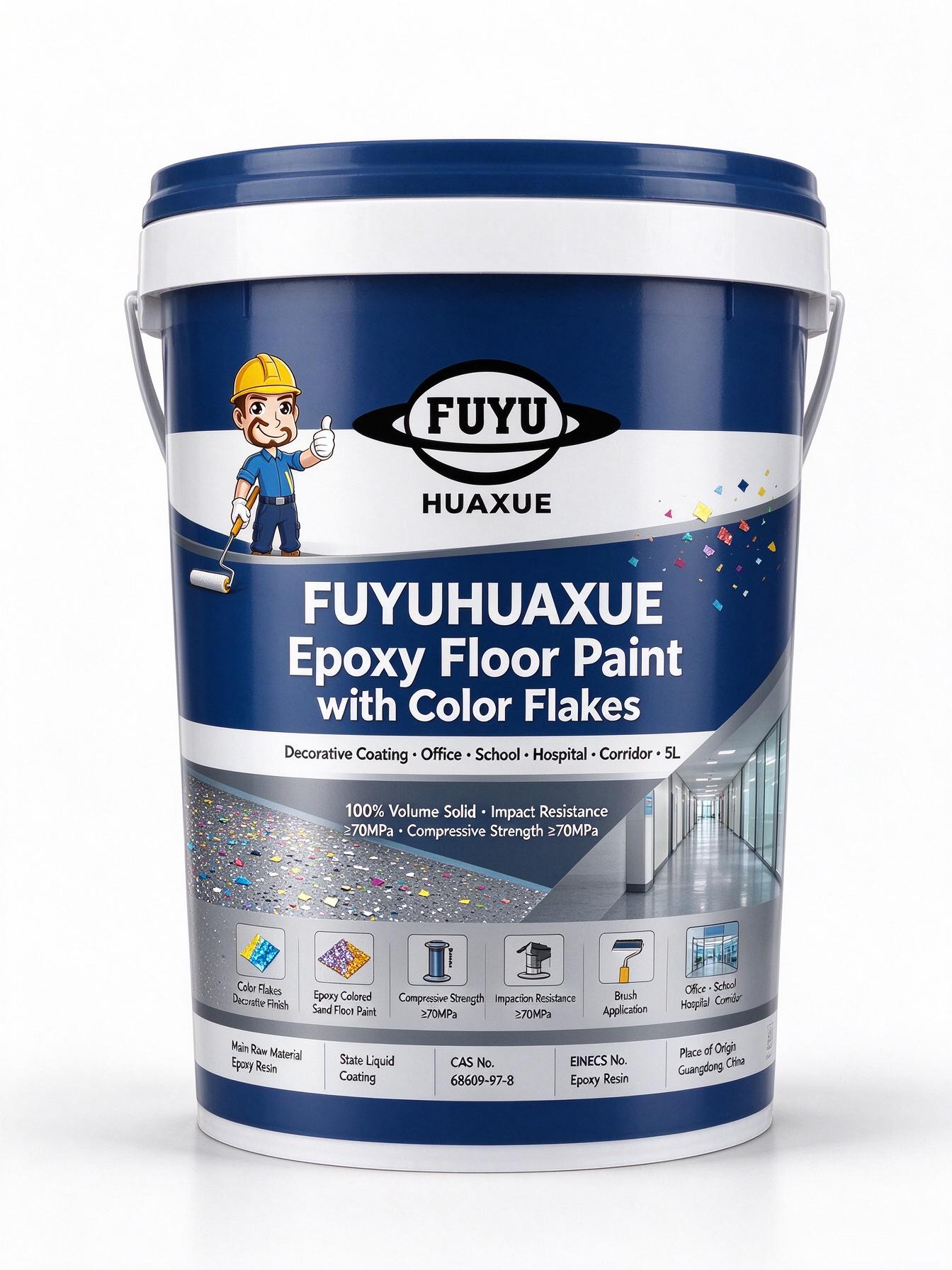
The formulation that answers this brief is a 100% solids epoxy system, identified under CAS No. 68609-97-2, with an epoxy resin backbone of (C₁₁H₁₂O₃)ₙ. “100% solids” is not a marketing label. It means the coating contains no solvent to evaporate; what is applied is what cures. The practical consequences matter in occupied buildings: low odor during installation and, in properly formulated systems, minimal VOC contribution to indoor air quality—characteristics repeatedly associated with 100% solids epoxy in institutional settings. For a hospital corridor that cannot shut down for a week, or a school that needs work done during a break, the difference between a solvent-heavy coating and a 100% solids system is the difference between a usable building and a closed wing.
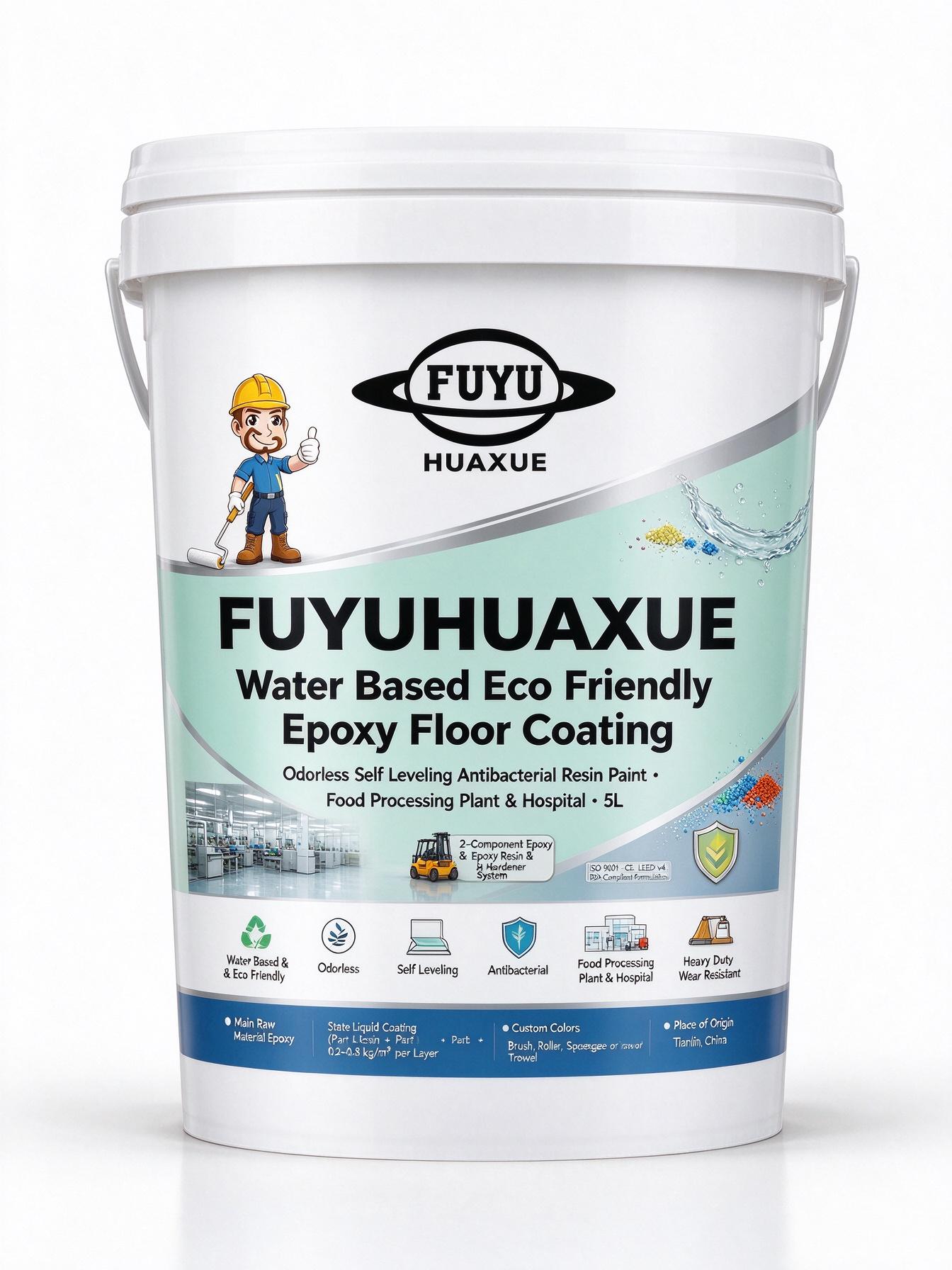
The mechanical numbers tell a similarly direct story. FUYUHUAXUE’s epoxy colored sand floor paint carries a compressive strength of ≥70 MPa and impact resistance of ≥70 MPa. In corridor terms, that translates to resistance against the concentrated point loads of gurneys, cleaning machines, delivery dollies, and the accumulated fatigue of ten thousand daily footfalls. The coating is applied by brush—a detail that sounds minor until you consider the realities of retrofit work: edges, corners, doorways, and cove bases are where most floor failures begin. Brush application allows the system to be carried into the junctions that roller-only application misses.
The decorative component is not an afterthought. Color flakes are broadcast into the wet epoxy base, then sealed. The result is a surface with visual depth and pattern variation that masks scuffs and daily soil far better than a monolithic solid color, while remaining completely seamless. The flake layer also contributes to slip resistance in the cured film, addressing the wet-floor risk that makes corridor safety a liability concern in schools and healthcare facilities alike. The system is available in customizable color blends, allowing a hospital to specify a wayfinding palette, a school to coordinate with house colors, and an office to match a brand identity—without sacrificing the underlying performance envelope.
A Single Specification, Three Institutional Logics
What makes this system unusually well-suited to the corridor typology is that it does not force a trade-off between the three environments. The same platform resolves the distinct pressures of each:
For hospitals, the seamless, non-porous surface supports infection control protocols by removing the grout lines and seams where pathogens accumulate. It resists the harsh disinfectants used in daily cleaning and stands up to the rolling loads of medical equipment. The decorative flake finish allows corridors and nurses’ stations—areas that are both high-traffic and public-facing—to be hygienic and welcoming at the same time, a balance that healthcare designers increasingly treat as part of patient experience rather than an optional extra.
For schools, the priority is safety underfoot without a clinical look. A seamless epoxy flake floor delivers anti-slip performance, easy removal of scuff marks and spills, and a finish that holds its appearance through the school year. The low-odor, 100% solids chemistry means work can proceed in occupied or adjacent buildings with less disruption than solvent-based alternatives. And because the system cures to a hard, continuous film, it eliminates the tile-and-grout failure cycle that consumes maintenance budgets in corridors with heavy footfall.
For offices, the floor is part of the first impression. Color-flake epoxy gives designers a customizable, speckled aesthetic that reads as intentional and contemporary, while the 100% solids film provides the abrasion and impact resistance that open-plan corridors and circulation zones demand. It cleans with standard mopping—no waxing, no stripping, no periodic burnishing program—which reduces both chemical use and labor hours in facilities where the corridor is cleaned every night.
The Cost Argument That Is Not About Price Per Square Meter
Institutional flooring decisions are rarely made on purchase price alone. The relevant metric is cost of ownership across the service life of the corridor. A tile floor that requires grout cleaning, periodic stripping and waxing, and eventual replacement of cracked units carries a maintenance burden that accumulates quietly in labor, chemicals, and downtime. A seamless 100% solids epoxy system eliminates those line items: there is no grout to scrub, no wax to apply, and no seam to fail. The surface is cleanable with standard procedures, and the decorative flake layer continues to perform as a wear surface rather than a sacrificial finish.
There is also the question of what the corridor communicates. A floor that looks tired—stained, scuffed, patched—sends a message about institutional attention that no signage can override. A decorative flake epoxy floor maintains its appearance under traffic because the pattern distributes visual variation across the surface; scuffs and soil are absorbed into the design rather than standing out against a monolithic field. That is not a cosmetic luxury. In hospitals, schools, and offices, the corridor is the most-seen interior surface in the building. It is doing public relations whether the facility manager intends it to or not.
The Bottom Line
The specification of a corridor floor is a small decision with an outsized footprint. It touches infection control, slip risk, maintenance labor, indoor air quality during installation, and the daily visual character of the institution. FUYUHUAXUE’s 100% solids epoxy color-flake coating—with its brush-applied, seamless film, ≥70 MPa compressive and impact strength, and customizable decorative finish—is engineered to hold all of those variables at once. It is not simply a paint for concrete. It is a continuous, cleanable, load-bearing surface designed for the one part of the building that never stops working.
For facility managers and specifiers evaluating corridor upgrades across healthcare, education, and commercial portfolios, the question is no longer whether a decorative flake epoxy can meet the performance brief. It is whether any other system can meet it without asking the corridor to compromise on hygiene, safety, or appearance.