 fuyuhuaxue@iumrs.com
Walk into a luxury hotel lobby, and the marble floor tells you something before anyone speaks. Walk into a hospital corridor, and the floor communicates hygiene and order. Walk into a warehouse, and the floor is judged by how it handles forklifts and chemical spills. For decades, these three environments demanded three completely different flooring solutions—polished stone for beauty, seamless resin for hygiene, and heavy-duty industrial coatings for durability. Specifiers accepted the trade-off as inevitable: you could have elegance or performance, but rarely both.
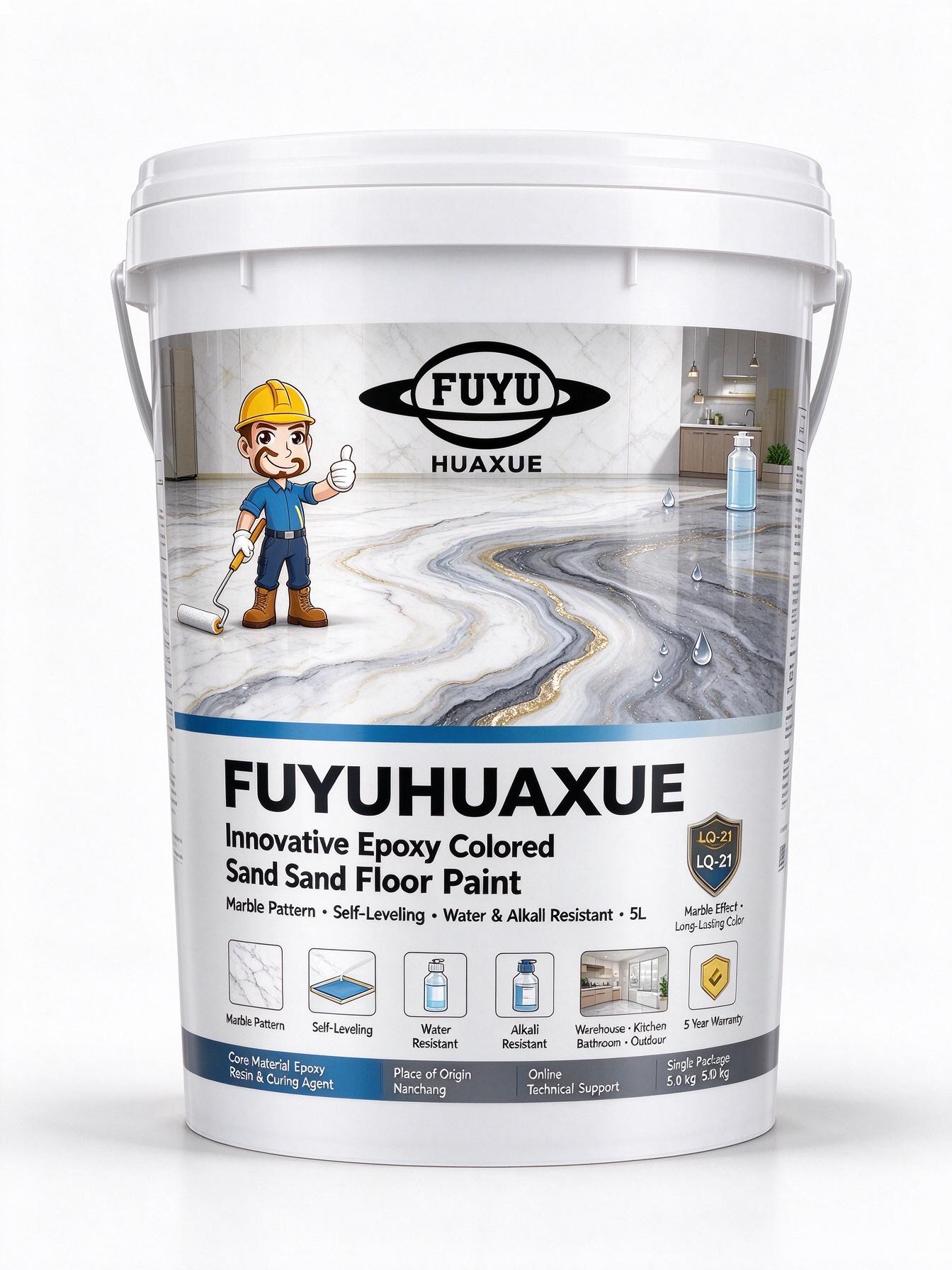
That assumption is now being challenged by a new generation of epoxy colored sand floor paints that reproduce the visual depth of natural marble while delivering the mechanical and chemical resistance of a 100% solids resin system. The technology—exemplified by the FUYUHUAXUE marble-pattern self-leveling epoxy floor coating (Model lq-21)—is not simply a prettier version of conventional epoxy. It is a reformulation of what a resin floor can be: decorative enough for living rooms and wine cellars, hygienic enough for hospitals and kitchens, tough enough for warehouses and workshops, and water- and alkali-resistant enough for bathrooms and outdoor courtyards. It is, in effect, a single platform that spans the entire spectrum of modern flooring demand.
The Marble Effect: Why Visual Depth Matters
Natural marble has been a symbol of permanence and refinement for centuries. Its veined patterns, subtle color transitions, and polished surface have made it a staple of churches, palaces, hotels, and high-end residences. But marble is heavy, expensive, porous, and prone to staining and etching—particularly in wet areas and spaces exposed to acids. It cracks under impact, requires periodic sealing, and is cold and slippery underfoot. For all its beauty, it is a difficult material to live with in high-traffic or moisture-prone environments.
The marble-pattern epoxy colored sand system solves this problem by decoupling the aesthetic from the material. Instead of quarrying stone, the coating uses colored sand and pigmented epoxy to create a surface with the visual depth and veining of marble, applied as a liquid and cured in place. The result is a floor that looks like stone but behaves like resin. It is seamless, non-porous, and repairable. It does not have the weight of marble, the porosity of marble, or the fragility of marble. And because it is applied as a coating rather than installed as slabs, it can cover large areas without joints, transitions, or the risk of individual tiles lifting or cracking.
The marble pattern is not merely decorative. In residential and commercial spaces, the veined effect masks scuffs, tire marks, and everyday soil far better than a monolithic solid color. A solid beige floor shows every footprint; a marble-pattern floor distributes visual variation across the surface, so the floor maintains its appearance longer and requires less frequent deep cleaning. In a bathroom, where water spots and soap residue are constant, this is a meaningful practical advantage. In a warehouse, where forklift tires leave dark marks on light floors, the marble effect hides the evidence of daily operations. And in a wine cellar or living room, the marble pattern delivers the aesthetic of natural stone without the maintenance burden of the real thing.
Self-Leveling: The Engineering of a Perfectly Flat Floor
The self-leveling property of the coating is one of its most important functional attributes. When the two-component epoxy system—resin, curing agent, and colored sand—is mixed and poured, it flows under its own weight, distributing evenly across the substrate and seeking its own level. This eliminates the need for troweling, leveling tools, or the labor-intensive screeding associated with conventional concrete or mortar floors. The result is a smooth, uniform surface with no high spots, low spots, or trowel marks.
In practice, self-leveling has several consequences. First, it produces a floor that is easier to clean, because there are no depressions where water, dirt, or chemical solutions can pool. Second, it creates a surface that is comfortable and safe to walk on, because there are no abrupt transitions or uneven edges that can cause tripping. Third, it reduces installation time, because the material does most of the leveling work itself. In a warehouse or factory, where downtime is expensive, this efficiency matters. In a bathroom or kitchen, where the floor must drain properly and feel smooth underfoot, it is essential. And in a living room or bedroom, where the floor is part of the aesthetic experience, the seamless, level finish is part of what makes the marble effect convincing.
The self-leveling property also contributes to the coating’s ability to bond uniformly to the substrate. Because the material flows into minor irregularities and fills small voids, it creates a continuous contact layer that reduces the risk of delamination, blistering, or hollow spots. This is particularly important in renovation projects, where the existing substrate may be uneven, patched, or worn. A self-leveling epoxy floor can often be applied directly over prepared concrete, eliminating the need for an intermediate leveling compound and reducing the overall thickness—and cost—of the flooring system.
Water and Alkali Resistance: The Chemistry of Durability
Two of the most damaging forces in any building are water and alkali. Water intrudes through cracks, seams, and porous surfaces, causing mold growth, concrete deterioration, and adhesive failure. Alkali—present in concrete, cleaning chemicals, and many industrial processes—attacks coatings from below and above, breaking down the resin matrix and causing discoloration, blistering, and loss of adhesion. In bathrooms, kitchens, warehouses, and outdoor spaces, these forces are constant.
The FUYUHUAXUE marble-pattern epoxy coating is formulated to resist both. The cured film is waterproof, meaning it prevents moisture from penetrating the substrate and protects the floor from water damage in high-use areas. This is particularly relevant in bathrooms, where shower spray, sink overflow, and wet foot traffic are routine; in kitchens, where spills and cleaning are constant; and in outdoor courtyards and entryways, where rain and humidity are unavoidable. The waterproof membrane also protects the substrate itself, extending the life of the concrete or screed beneath the coating and reducing the risk of structural deterioration.
Alkali resistance is equally important, particularly in workshops, factories, and warehouses where chemical exposure is common. Alkaline substances—including many cleaning agents, concrete efflorescence, and industrial process chemicals—can degrade lesser coatings, causing them to chalk, peel, or lose their bond. The epoxy chemistry in this system is engineered to withstand alkaline attack, maintaining its integrity and appearance even under repeated exposure. This makes the coating suitable for environments where conventional floor paints would fail within months, and it explains why the product carries a five-year warranty—a claim that reflects confidence in the long-term chemical stability of the cured film.
A Five-Year Warranty and the Meaning of Long-Lasting Color
The product’s five-year warranty is not a marketing gesture. It is a statement about the durability of the cured system under real-world conditions. Epoxy floors are often judged by how they look after two or three years of traffic, cleaning, and chemical exposure. A floor that fades, yellows, or loses its pattern within that timeframe is not a successful floor, regardless of how it looked on installation day. The marble-pattern coating is engineered for long-lasting color, with pigments and sand blends that resist fading and UV degradation. This means the marble effect remains visually consistent over time, and the floor continues to deliver the aesthetic that justified its specification.
The warranty is supported by online technical support, which is particularly valuable for contractors, facility managers, and homeowners who may be applying the product for the first time. Technical guidance on substrate preparation, mixing ratios, application thickness, curing conditions, and maintenance procedures can mean the difference between a floor that performs for a decade and one that fails within a year. The availability of this support reflects a broader shift in the coatings industry toward service-oriented product offerings, where the manufacturer’s role extends beyond the point of sale.
From Warehouse to Wine Cellar: A Single Platform for Diverse Spaces
One of the most striking aspects of this product is the breadth of its application list. It is suitable for floors in office buildings, hospitals, schools, malls, sports venues, leisure facilities, warehouses, supermarkets, workshops, parks, courtyards, farmhouses, kitchens, bathrooms, home offices, living rooms, bedrooms, children’s rooms, outdoor areas, storage rooms, entryways, wine cellars, gyms, shopping malls, factories, and homes. This is not a case of a product being stretched to cover every possible use; it is a case of a technology that genuinely resolves the competing demands of different environments.
In a warehouse or factory, the coating provides the mechanical strength, chemical resistance, and abrasion tolerance needed for forklifts, pallets, and industrial cleaning. In a bathroom or kitchen, it provides the waterproofing, mold resistance, and easy-clean surface needed for hygiene. In a living room, bedroom, or wine cellar, it provides the marble aesthetic and seamless finish that make the space feel refined and complete. In a school or hospital, it provides the seamless, non-porous surface that supports infection control and reduces maintenance labor. In an outdoor courtyard or entryway, it provides the water and alkali resistance needed to withstand weather and foot traffic.
The common thread is the epoxy chemistry itself. Epoxy resin, when properly formulated with a curing agent and colored sand, produces a thermoset film that is hard, chemically resistant, dimensionally stable, and capable of bonding tenaciously to prepared substrates. By adjusting the pigment, sand blend, and application thickness, the same basic chemistry can be tuned for different environments without changing its fundamental performance characteristics. This is what makes a single product line viable across such a wide range of applications—and what makes the marble-pattern variant particularly versatile, because it combines the decorative appeal of natural stone with the functional performance of industrial resin.
Practical Considerations: Packaging, Origin, and Application
The product is supplied as a single item with a package size of 110×110×1 cm and a gross weight of 5.0 kg, a format that is practical for contractors, distributors, and end users alike. The place of origin is Nanchang, and the model number is lq-21, providing traceability for procurement teams who need to verify sourcing and quality control. The core material is epoxy resin, and the system is a two-component formulation of resin and curing agent, mixed on site and applied as a liquid coating.
Application is straightforward for trained contractors: prepare the substrate, mix the components, pour and spread the self-leveling material, and allow it to cure. The marble effect is achieved through the interaction of the colored sand and the pigmented resin, which creates a natural-looking pattern as the material flows and levels. Because the pattern is inherent in the material rather than printed or applied as a surface layer, it does not wear away or delaminate. The floor can be cleaned with standard neutral cleaners, and heavy-duty cleaning equipment can be used without damaging the surface.
The Bottom Line: A Floor That Works as Hard as It Looks
The marble-pattern epoxy colored sand floor paint represents a meaningful advance in flooring technology. It offers the visual richness of natural stone without the weight, porosity, and fragility of marble. It offers the seamless hygiene of resin without the clinical coldness of conventional epoxy. It offers the mechanical and chemical resistance of an industrial coating without sacrificing the aesthetic demands of residential and commercial interiors. And it offers a five-year warranty, online technical support, and a formulation that resists water, alkali, and fading—attributes that matter in every environment from the bathroom to the warehouse.
For specifiers, facility managers, contractors, and homeowners, the appeal is straightforward: one product, many applications, and a finish that looks like it belongs in a design magazine while performing like it was engineered for a factory floor. In a market where flooring decisions are too often a compromise between beauty and durability, the marble-pattern epoxy floor is a rare thing—a surface that refuses to choose. It is, quite literally, the best of both worlds, poured, leveled, and cured into a single seamless sheet.