购物车里没有产品。
 fuyuhuaxue@iumrs.com
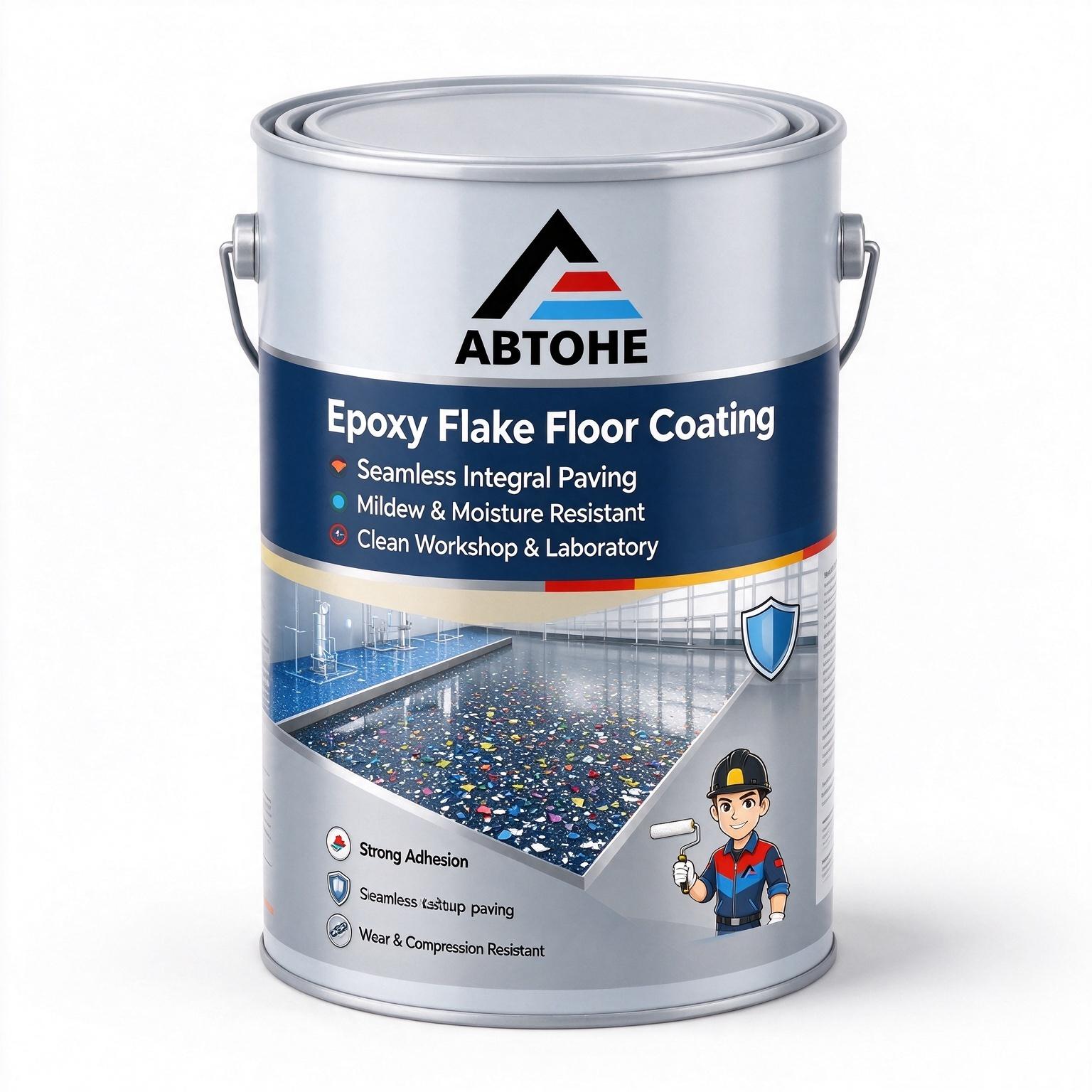
Look closely at the floor of any laboratory, clean workshop, or precision manufacturing hall and you will find that the specification question is rarely about color or gloss. It is about continuity. Every joint, every seam, every crack, every transition strip is a place where moisture gathers, where mold spores settle, where chemical residue accumulates, and where the clean-room protocol that the entire facility was built around quietly breaks down. A floor is not clean because it was cleaned. It is clean because it has nowhere for contamination to hide.
That is the engineering logic behind ABTOHE’s Epoxy Resin Floor Paint for Workshop Seamless Integral Paving — a two-component epoxy resin floor coating system, models CYDHD-200 and CYDHD-250, formulated for factories, workshops, parking lots, and, most notably, mildew-proof and moisture-proof laboratories and clean workshops. It is supplied as a liquid epoxy resin (Agent A) with a matched curing hardener (Agent B), mixed in proportion and applied by brushing and scraping to form a continuous, integral film. The result is a floor with no seams to fail, no joints to harbor moisture, and no porous surface for mildew to colonize — a surface that behaves as a single engineered membrane rather than as a collection of tiles or panels.
The Moisture Problem in Laboratories and Clean Workshops
Clean rooms and laboratories are humidity-controlled environments by design, but the floor is where moisture control is most often compromised. Concrete slabs wick moisture from below. Joints and cracks admit liquid from above. Porous surfaces hold residual cleaning solution and condensation. In a laboratory setting, that moisture combines with chemical vapors and biological residue to create exactly the conditions that mildew and microbial growth require. In a clean workshop, it undermines the particulate control that the room was built to achieve.
A seamless integral epoxy floor addresses the problem at the source. By eliminating joints and seams, the coating removes the primary pathways for moisture ingress and contamination accumulation. The cured epoxy film is moisture-resistant and non-porous, forming a barrier that prevents liquid from penetrating the substrate and resists the surface conditions that support mildew growth. For laboratories handling sensitive reagents, and for clean workshops producing components where contamination means scrap, this is not an aesthetic upgrade. It is a functional requirement of the room.
ABTOHE’s system is specifically positioned for mildew-proof and moisture-proof applications in these environments, and the formulation reflects that priority: a dense, continuous film with strong adhesion to the substrate, chemical resistance to acids, alkalis, and oils, and a surface that can be cleaned thoroughly without degrading. The floor does not merely tolerate clean-room protocol; it supports it.
Seamless Integral Paving: What It Actually Means
The phrase “seamless integral paving” is often used loosely in the coatings market. In practical terms, it describes a floor installation in which the coating is applied as a continuous liquid film across the entire surface area, curing into a single integrated membrane with no mechanical joints, no panel boundaries, and no transition seams. The applicator works the material across the floor by brush and scraper, building a uniform film that bonds directly to the prepared substrate and remains continuous from wall to wall.
That continuity has consequences that extend well beyond hygiene. A seamless floor distributes load uniformly, which reduces the point-loading failures that crack tiled or jointed surfaces under forklift traffic and heavy equipment. It eliminates the edge-lifting failure mode that begins at seams and propagates across the floor. It simplifies cleaning, because there are no grout lines or joints where soil collects and where cleaning equipment cannot reach. And it improves the visual finish, because a continuous surface reflects light uniformly and reads as a designed, finished floor rather than an assembled one.
For factories and workshops, the practical benefit is a floor that stays intact under industrial traffic. For parking lots, it is a waterproof surface that resists oil, fuel, and de-icing salts. For laboratories and clean workshops, it is the physical foundation of contamination control.
The Two-Component System: Chemistry That Performs After Mixing
ABTOHE’s epoxy floor paint is a two-component system. Agent A is liquid epoxy resin, identified by CAS No. 24969-06-0 and EINECS No. 607-468-0, with the main raw material being epoxy resin. Agent B is the matched curing hardener. The two components are mixed in the specified proportion immediately before application, initiating the crosslinking reaction that transforms the liquid coating into a cured, durable film.
That two-component architecture is what separates a genuine epoxy floor system from a single-component paint. The crosslinked film delivers strong adhesion to concrete and other hard substrates, wear resistance, compression resistance, and chemical resistance to acid, alkali, and oil exposure. It also provides the moisture resistance that makes the system suitable for mildew-prone environments. A single-component water-based coating can look similar on the day of application; it cannot match the performance of a properly cured two-component epoxy over its service life.
The application methods supported — brushing, scraping, and rolling — reflect the system’s flexibility across project scales. Brushing is suited to edges, corners, and detail work. Scraping builds film thickness and compacts the material against the substrate for maximum adhesion. Rolling covers broad floor areas efficiently. A contractor can combine methods within a single project to match the geometry of the space, which is particularly useful in laboratories and workshops where equipment, benches, and partitions create complex floor plans.
The Performance Profile: Adhesion, Wear, Compression, Corrosion, Moisture
The product description lists the core advantages precisely, and each one answers a real failure mode that facility owners have already encountered.
Strong adhesion is the foundation of every other property. A coating that does not bond firmly to the substrate will eventually lift, blister, or delaminate — and once it does, the floor must be repaired rather than maintained. ABTOHE’s system is formulated for firm bonding to prepared concrete, which is why it can be specified for seamless integral paving rather than localized patching.
Wear resistance addresses the abrasion that erodes conventional floor finishes under foot traffic, cart wheels, and equipment movement. In factories and workshops, where traffic is continuous, abrasion resistance determines the recoat interval and therefore the long-term maintenance cost.
Compression resistance addresses point loading and impact. Heavy equipment, pallets, and vehicle traffic apply concentrated stress that thin or weakly built coatings cannot absorb. A properly built epoxy film distributes that load across the surface and resists crushing at contact points.
Dustproof performance eliminates the concrete dusting that contaminates product and drives cleaning labor. A sealed, continuous epoxy surface stops the substrate from shedding particulate, which is critical in clean workshops and laboratories where airborne contamination is unacceptable.
Easy cleaning follows directly from the seamless, non-porous surface. There are no joints for soil to accumulate in, no texture to trap residue, and no porous areas that absorb liquids. Cleaning becomes faster and more effective, which reduces both labor cost and the risk of residual contamination.
Corrosion resistance to acids, alkalis, and oils protects the floor in chemical environments, maintenance areas, and parking lots exposed to automotive fluids. Combined with moisture resistance, it makes the system suitable for the laboratory and workshop settings where spills are routine rather than exceptional.
Moisture resistance is the property that underpins the mildew-proof positioning. A floor that resists moisture penetration denies mildew the conditions it needs to grow, and protects the substrate from the moisture-driven deterioration that shortens the life of both the coating and the concrete beneath it.
Types and Selection: One Platform, Multiple Duties
ABTOHE’s product description identifies several common types within the epoxy floor paint category: general-purpose flat-coat epoxy floor paint, mirror-effect self-leveling epoxy floor paint, anti-static epoxy floor paint, wear-resistant and anti-corrosion epoxy floor paint, and water-based environmental protection models. The CYDHD-200 and CYDHD-250 models sit within this platform, and the availability of multiple types allows specifiers to match the coating to the duty profile of each zone.
A laboratory may require anti-static performance in one room and moisture resistance in another. A workshop may need wear-resistant anti-corrosion coating in the machining area and a general-purpose flat coat in the storage zone. A parking lot may need a waterproof, oil-resistant surface with anti-slip texture. Because the platform spans these requirements, a single supplier can support a multi-zone project without requiring the facility to manage multiple coating systems, color standards, and application methods.
The color specification is customizable, which matters more than it first appears. In clean workshops and laboratories, color can define zones, indicate walkways, and support visual management systems. In commercial and office areas attached to industrial facilities, it allows the floor to match the interior design rather than defaulting to industrial gray. The product name references “Multiple Color Options,” and the customized color capability extends across the platform.
Eco-Friendly Formulation and Practical Logistics
The system is described as eco-friendly, which in the epoxy floor paint category generally reflects lower odor and reduced solvent content relative to traditional solvent-based coatings. That property matters during application in occupied buildings and in laboratories where adjacent spaces must remain operational. It also aligns with the indoor air quality requirements that increasingly govern commercial and institutional projects.
Packaging and delivery are structured for project procurement: single-item selling units, a package size of 30 × 30 × 45 cm, and a gross weight of 25.0 kg. The 25 kg packaging is a practical unit for contractor handling — large enough to cover meaningful floor area, small enough to be moved and mixed without specialized lifting equipment. The single-package configuration simplifies ordering and inventory for projects of varying scale.
ABTOHE is based in Shandong, China, a region with established chemical and coatings manufacturing infrastructure and export logistics. The product carries traceable technical identifiers — CAS No. 24969-06-0 and EINECS No. 607-468-0 — which matter to importers, industrial buyers, and compliance teams evaluating the material against project specifications and customs documentation requirements.
Where the System Belongs
The application profile is broad because the performance envelope is broad. The system is suitable for factories, workshops, parking lots, warehouses, shopping malls, offices, hospitals, and other areas requiring a durable, cleanable, seamless floor.
In factories and workshops, the value is wear resistance, compression resistance, and a seamless surface that handles equipment traffic and simplifies housekeeping. In laboratories and clean workshops, the value is the mildew-proof and moisture-proof performance that supports contamination control. In parking lots, the value is waterproofing, oil and chemical resistance, and load bearing. In warehouses, the value is dustproofing and easy cleaning under forklift traffic. In shopping malls, offices, and hospitals, the value is a clean, attractive, low-maintenance floor that meets hygiene expectations without the maintenance burden of tile or stone.
The common thread is not a single industry. It is a single requirement: a floor that performs as a continuous, integral membrane rather than as an assembly of pieces — because the seams are where floors fail, and seamless integral paving is how they stop failing.
The Floor as Infrastructure
A floor is the largest continuous surface in any building, and it is the one surface that every worker, visitor, and process interacts with directly. Specifying it as an afterthought is a costly habit. Specifying it as an engineered system — two-component epoxy resin, matched curing hardener, seamless integral application by brush and scraper, mildew-proof and moisture-proof performance — is how facilities avoid the cycle of patch, recoat, and replace.
ABTOHE’s Epoxy Resin Floor Paint for Workshop Seamless Integral Paving is positioned precisely at that intersection of practicality and performance. It protects the ground from wear, oil pollution, and acid-base corrosion. It presents a clean, attractive decorative effect. It combines practicality with ornamental value. And it does so as a continuous, integral surface — the specification that laboratories, clean workshops, and factories have been asking for all along.
For the facility manager comparing bids, it is the line item where the lowest total cost of ownership is not an accident but a formulation decision. For the clean-room supervisor, it is the surface that finally has nowhere for contamination to hide. For the contractor, it is a system that applies with familiar tools — brush, scraper, roller — and cures into a floor that performs. That is what seamless integral paving means when it is done properly: not just a floor without seams, but a floor without weaknesses.