 silicone@silic0ne.com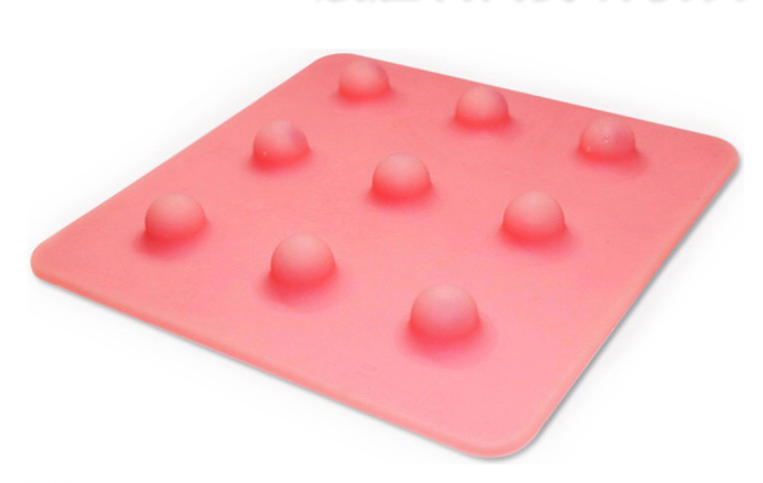
In the evolution of modern surgery, few advances have transformed patient care as profoundly as the adoption of minimally invasive techniques. Laparoscopic surgery—performed through small incisions with specialized instruments and camera guidance—has become the standard of care for procedures ranging from cholecystectomy and appendectomy to complex colorectal resections and bariatric surgery. Patients benefit from reduced pain, shorter hospital stays, faster recovery, and improved cosmetic outcomes.
Yet this revolution in patient care has created an equally profound challenge in surgical education. Laparoscopic surgery demands a fundamentally different skill set than traditional open procedures. The surgeon must operate while viewing a two-dimensional monitor, manipulate long instruments that amplify tremor and reverse intuitive hand movements, and perform complex maneuvers in confined spaces with limited depth perception. Among the most critical—and最难掌握—of these skills are the three pillars of laparoscopic technique: dissection, shearing, and suturing.
Recognizing the need for comprehensive, progressive training in these essential skills, we are proud to introduce the Laparoscopic Dissection, Shearing, and Suturing 9-Module Training Pad (Model No: BL23120001) . This 138*138*15mm silicone platform integrates nine distinct practice zones into a single, durable training aid, specifically engineered to prepare surgical residents, fellows, and practicing surgeons for the realities of minimally invasive surgery.
The Three Pillars of Laparoscopic Proficiency
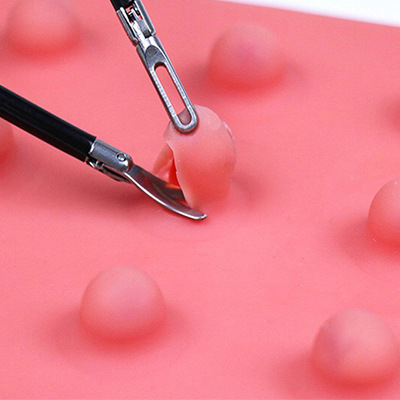
To appreciate the value of a dedicated multi-module trainer, one must first understand why dissection, shearing, and suturing represent distinct skill domains that require targeted practice.
Dissection: The Art of Finding Planes
Surgical dissection—the process of separating tissues along natural anatomical planes—is fundamental to virtually every laparoscopic procedure. Whether exposing the cystic duct during cholecystectomy, mobilizing the colon during resection, or developing the peritoneal flaps for hernia repair, dissection requires:
- Delicate tissue handling to avoid unnecessary trauma
- Precise traction and counter-traction to reveal planes
- The ability to distinguish between areolar tissue, fascia, and vascular structures
- Coordinated use of two instruments working in harmony
Shearing: Precision Cutting Under Visualization
Laparoscopic shearing—cutting tissue with scissors or energy devices—demands a level of precision that exceeds open surgery. With limited tactile feedback and two-dimensional visualization, the surgeon must:
- Position scissors at the correct angle for clean division
- Apply appropriate tension before cutting
- Anticipate tissue recoil after division
- Avoid injury to adjacent structures hidden from view
Suturing: The Ultimate Test of Laparoscopic Skill
Intracorporeal suturing and knot tying represent the apex of laparoscopic technique. These skills require:
- Needle driving with precise entry and exit angles
- Two-handed coordination for knot tying
- Appropriate tension management
- Spatial reasoning to place sutures in three-dimensional space while viewing a two-dimensional screen
The [silic0ne] Solution: Nine Modules, One Comprehensive Platform
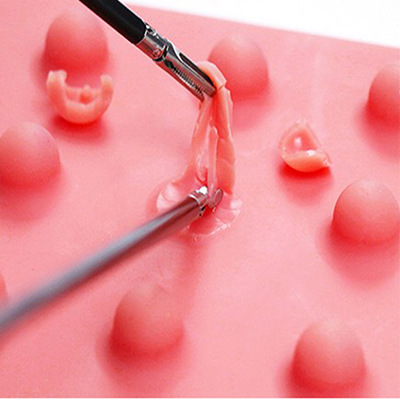
Our 9-in-1 Laparoscopic Training Pad addresses these essential skills through thoughtful design and premium material selection. Measuring 138mm square with 15mm thickness, the module fits comfortably within standard laparoscopic box trainers while providing an expansive practice surface.
Multi-Zone Architecture for Progressive Skill Development
The pad features nine distinct training zones, each designed to target specific aspects of laparoscopic technique:
| Zone | Skill Focus | Training Application |
|---|---|---|
| 1-2 | Basic Dissection | Developing tissue planes, blunt dissection technique |
| 3-4 | Advanced Dissection | Fine areolar tissue separation, vessel exposure |
| 5-6 | Precision Shearing | Scissor control, cutting along marked lines |
| 7-8 | Suturing Foundations | Needle driving, simple interrupted sutures |
| 9 | Complex Suturing | Intracorporeal knot tying, continuous sutures |
This integrated design allows learners to progress from fundamental skills to advanced techniques without changing modules—a significant advantage for both self-directed practice and structured curricula.
3D Topography for Anatomical Realism
Unlike flat practice surfaces, our module features subtle three-dimensional contours that mimic the irregular surfaces encountered during actual laparoscopy. This topography challenges learners to adapt their technique to varying tissue planes—a critical skill for procedures such as laparoscopic pyeloplasty, fundoplication, or myomectomy.
Material Excellence: Food-Grade Silicone for Surgical Training
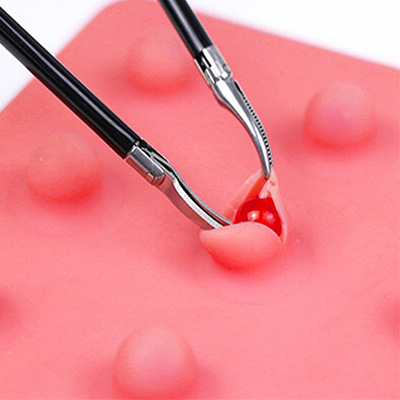
The choice of material for a laparoscopic training module has profound implications for both educational effectiveness and product longevity. Our module is constructed from 100% food-grade silicone, a decision that confers multiple advantages.
Tactile Authenticity
Our silicone formulation is calibrated to approximate the durometer and elastic modulus of human peritoneal tissues and fascia. When a dissecting instrument applies traction, the material yields with resistance similar to living tissue. When scissors divide the surface, the feedback approximates the sensation of cutting through areolar planes. When a needle passes through, it encounters realistic resistance before penetrating. This haptic fidelity accelerates the transfer of skills from simulation to the operating room.
Anti-Tear Engineering
One of the most common frustrations with practice pads is their tendency to tear or split when instruments apply tension—a particular concern in dissection training, where traction and counter-traction are essential techniques. Our composite silicone formulation is specifically engineered to withstand aggressive manipulation without failure. Even when learners make mistakes or apply excessive force, the material maintains its integrity.
Self-Sealing Properties
Repeated instrument passes through any material eventually create permanent tracks. Our silicone formulation minimizes track enlargement through its elastic self-sealing properties, maintaining a consistent practice surface for hundreds of repetitions. This durability transforms the module from a consumable supply into a long-term educational investment.
Absolute Purity
Food-grade silicone contains no fillers, plasticizers, or potentially harmful additives. This means:
- No off-gassing: The module emits no odors, making it suitable for use in enclosed simulation centers
- No skin irritation: Safe for prolonged handling by multiple users
- Easy cleaning: Can be sanitized with mild soap and water or alcohol wipes between users
Comprehensive Skill Development: From Fundamentals to Fluency
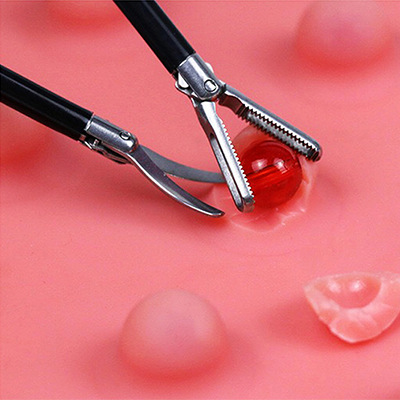
The 9-module design supports a structured curriculum that accommodates learners at every stage of their surgical education.
Foundational Skills
For residents encountering laparoscopic dissection and shearing for the first time, the module provides a forgiving environment for mastering the basics:
- Instrument handling and camera navigation
- Basic blunt dissection using atraumatic graspers
- Scissor positioning and cutting technique
- Tissue manipulation without tearing
Intermediate Techniques
As proficiency develops, learners advance to more challenging exercises:
- Fine dissection along marked planes
- Precise shearing of defined geometric shapes
- Needle loading and positioning for suturing
- Simple interrupted suture placement
Advanced Applications
For fellows and practicing surgeons, the module supports sophisticated skill development:
- Dissection in confined spaces and awkward angles
- Two-handed coordination for complex maneuvers
- Intracorporeal knot tying under time pressure
- Continuous suturing for wound closure
Integrated Skill Practice
The true power of the 9-module design lies in its ability to support integrated practice—combining dissection, shearing, and suturing in sequence, just as in actual surgical procedures. Learners can dissect a tissue plane, sharply divide a structure, and close the resulting defect with sutures—all on a single training platform.
The Science of Simulation: Evidence-Based Design

The design of our laparoscopic training module is informed by research in surgical simulation and skill acquisition. Studies have demonstrated that structured practice on tissue-mimetic models significantly improves laparoscopic performance.
The Importance of Realistic Tissue Properties
Research from academic medical centers has validated the use of silicone-based models for laparoscopic dissection training. These studies demonstrate that models calibrated to match the mechanical properties of living tissue—in terms of toughness, elasticity, and peel strength—provide effective transfer of skills to clinical practice.
Deliberate Practice Principles
Effective skill development requires more than mere repetition—it demands deliberate practice with specific goals, immediate feedback, and progressive challenge. Our 9-module design supports this pedagogical approach by offering varied challenges within a single training aid, allowing learners to track their progress across multiple skill domains.
The Export Advantage: Engineered for Global Distribution

As a manufacturer committed to serving the international surgical education community, we design every product with the requirements of global distribution in mind. Our 9-module Laparoscopic Training Pad is engineered to meet the expectations of regulators, distributors, and end users worldwide.
ISO 13485: The Language of Medical Quality
While training modules are typically classified as educational aids rather than medical devices, they are manufactured in facilities that embrace the principles of ISO 13485—the international standard for medical device quality management systems. This commitment ensures:
- Design Verification: Every aspect of the module’s performance is documented and validated
- Process Control: Manufacturing processes are monitored to ensure consistent quality across production batches
- Traceability: Each module can be traced to its raw material source and production date
Supporting Regulatory Submissions
For distributors entering regulated markets, we provide comprehensive technical documentation:
- Material safety data sheets (MSDS) confirming food-grade compliance
- Biocompatibility documentation per ISO 10993 standards
- Technical files to support CE marking applications
- Declaration of conformity for customs clearance
Customization Capabilities (OEM Services)
We recognize that different programs and markets have unique requirements. As indicated by the OEM brand designation, we offer comprehensive customization services:
- Thickness Variations: Adjusting the 15mm profile to suit specific training protocols
- Zone Configuration: Customizing the number, size, and pattern of training zones
- Color Options: Differentiating zones or tissue layers for enhanced visual feedback
- Logo Printing: Branding modules for distributors or institutions
- Private Labeling: Complete OEM solutions for your brand
Practical Design for Simulation Centers

A training tool must not only perform well but also integrate seamlessly into the workflow of surgical simulation programs. Our module is designed with practical considerations in mind.
Individual Protection
Each module is individually wrapped in a non-woven fabric bag, protecting the silicone surface from dust, abrasion, and contamination during storage and transit. This individual packaging also facilitates hygienic distribution to multiple learners and maintains product freshness.
Compact Storage
The wrapped module is housed in a compact, branded box designed for efficient storage. The minimal footprint allows simulation centers to stock multiple modules without consuming valuable space.
Optimized Freight Economics
International shipping costs can significantly impact the viability of distribution partnerships. Our master carton configuration is meticulously calculated for maximum efficiency:
- 40 modules per carton
- Carton dimensions: 34 x 34 x 22cm
- Gross weight: Optimized for handling and freight cost minimization
This configuration minimizes dimensional weight charges for air freight while maximizing container utilization for sea shipments, ensuring competitive landed costs for our distribution partners.
Why Integrated Training Matters

The acquisition of laparoscopic skills follows a predictable learning curve, but the slope of that curve depends critically on the quality and availability of practice opportunities.
The Simulation Imperative
Research in surgical education consistently demonstrates that skills acquired in simulation transfer effectively to the operating room. Conversely, inadequate simulation training correlates with longer operative times, higher complication rates, and increased surgeon stress during initial clinical cases.
Patient Safety Considerations
The ethical imperative to protect patients from unnecessary risk demands that surgeons achieve basic proficiency before performing procedures on living humans. High-fidelity simulation, supported by quality training tools, enables this prerequisite skill development.
Competency-Based Education
Modern surgical training is increasingly moving toward competency-based models, where learners advance based on demonstrated skill rather than time served . Our 9-module trainer supports this paradigm by providing objective metrics of performance across multiple skill domains.
Building a Partnership for Global Surgical Education
We view ourselves not merely as manufacturers but as partners in the global mission to advance surgical education and improve patient outcomes. Every product we develop is informed by direct feedback from surgical educators, program directors, and residents—the end users who understand best what makes training effective.
Support for Distributors
We provide our distribution partners with comprehensive support:
- Technical Documentation: Material specifications, safety data sheets, and compliance files
- Marketing Materials: Product imagery, specification sheets, and demonstration videos
- Regulatory Assistance: Documentation to support CE marking and other regional approvals
- Volume Pricing: Attractive terms for bulk orders and long-term partnerships
Custom Manufacturing Expertise
Beyond our standard products, we offer comprehensive custom manufacturing services for silicone medical training aids and other silicone products. Whether you need:
- Modifications to existing designs
- Entirely new products developed from your specifications
- Private labeling for your brand
- Custom packaging solutions
Our experienced team is ready to bring your vision to reality. Simply send us your samples or specifications, and we will handle the rest.
The Future of Laparoscopic Training
As surgical technology continues to advance, the procedures available to patients grow increasingly sophisticated. Robotic surgery, single-incision laparoscopy, and natural orifice transluminal procedures demand ever-greater precision and adaptability from surgeons. The practitioners who will lead this field tomorrow are the residents training today.
The 9-in-1 Laparoscopic Dissection, Shearing, and Suturing Module represents a significant advancement in preparing those practitioners for the challenges they will face. By integrating nine distinct training zones into a single platform, combining realistic material properties with durable construction, and offering comprehensive customization options, we provide surgical educators a tool specifically designed for the unique demands of minimally invasive technique.
For the resident practicing dissection planes late into the evening, for the fellow refining shearing precision, for the experienced surgeon maintaining suturing skills—this module delivers the practice necessary for precision, confidence, and optimal patient outcomes.
Conclusion
In surgical education, there is no substitute for hands-on experience. Yet the days of learning exclusively in the operating room—with all the ethical and practical concerns that entails—are rightfully receding. Simulation has emerged as the essential bridge between classroom theory and clinical reality, and high-quality training tools are the foundation of that bridge.
Our brand stands for quality, realism, and global readiness. The Laparoscopic Dissection, Shearing, and Suturing 9-Module Training Pad, with its optimal dimensions, food-grade silicone construction, and OEM customization capabilities, offers international distributors and surgical training programs a product that meets the rigorous demands of modern minimally invasive surgical education.
Whether you supply medical schools in Europe, surgical residency programs in North America, or simulation centers across Asia, this module delivers the performance your customers demand and the compliance your business requires.
The art of laparoscopic surgery demands mastery of dissection, shearing, and suturing. Contact us today to discuss wholesale partnerships, OEM customization options, and how our custom manufacturing capabilities can support your success in the global surgical education market. Volume discounts available for qualified partners.
Contact me for custom procurement.:silicone@silic0ne.com