 silicone@silic0ne.com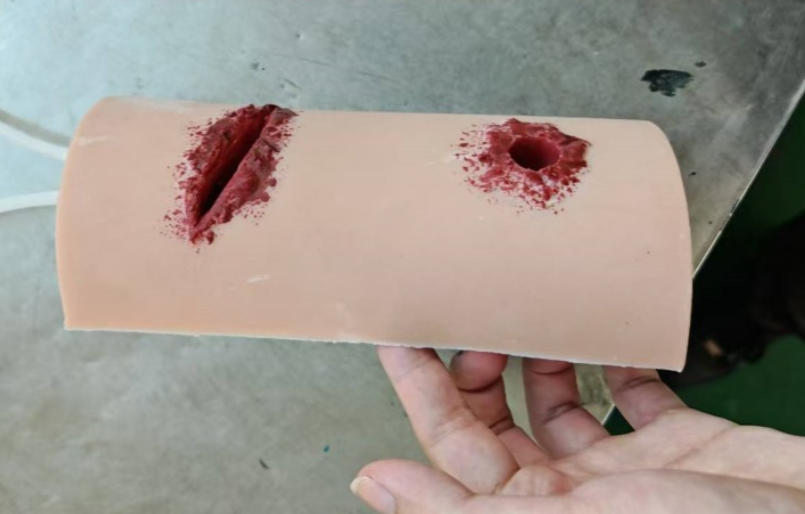
In the chaotic moments following a traumatic injury—whether on a battlefield, at the scene of a mass casualty incident, or in a civilian emergency department—the difference between life and death often hinges on the speed and skill of the first responders. For military medics, combat lifesavers, and emergency medical personnel, the ability to rapidly assess and treat penetrating trauma is not merely a technical skill—it is a survival imperative.
The landscape of modern warfare has made this training more critical than ever. Data from recent conflicts demonstrate that hemorrhage from junctional injuries remains the most common cause of preventable battlefield death. The war in Ukraine, characterized by high attrition rates and frequent use of heavy weapon systems, has resulted in an increasing number of casualties presenting with wound patterns caused by fragmentation from exploding ordnance—catastrophic hemorrhages with multiple points of bleeding. These complex injury patterns demand equally sophisticated training solutions.
Yet traditional approaches to trauma training have faced significant limitations. Cadaveric dissection, while valuable, is expensive, logistically challenging, and unavailable in most deployed settings. Live tissue training raises ethical concerns and practical constraints. Simple manikins lack the fidelity necessary to develop the tactile skills required for wound packing, hemorrhage control, and surgical intervention.
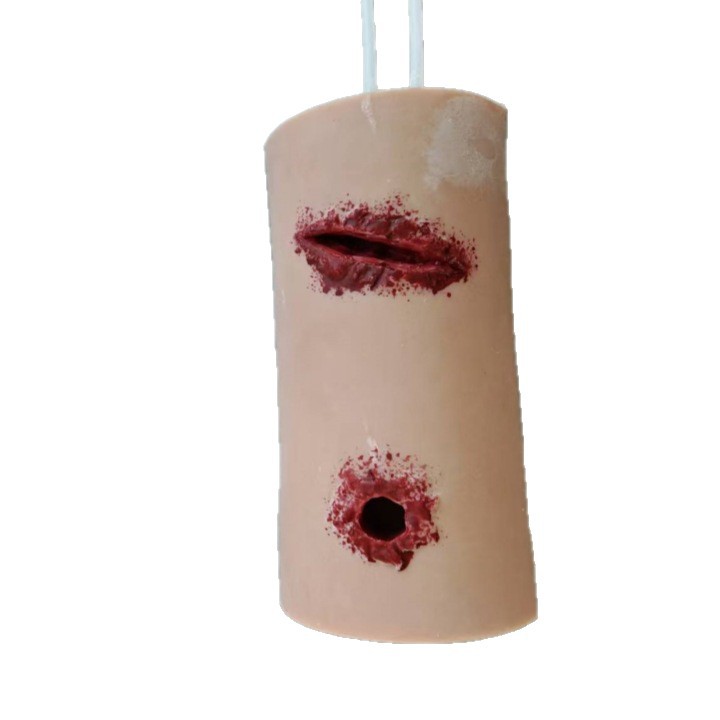
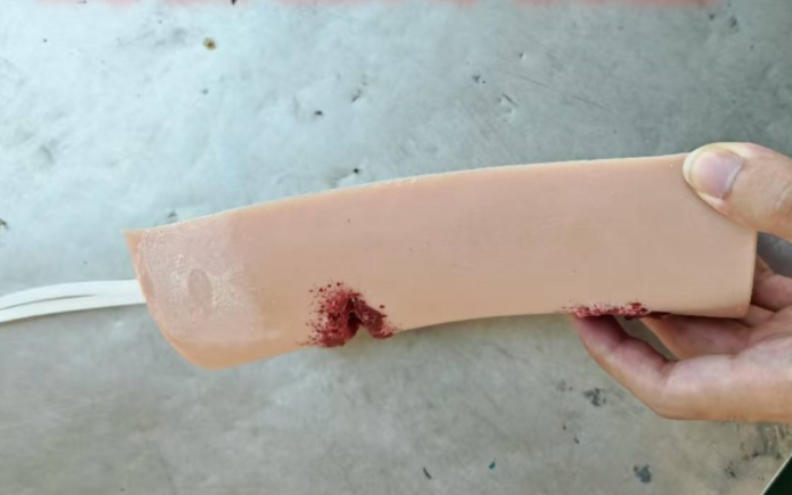
Enter the [silic0ne] War Trauma Medical Model —a 200*100*50mm silicone training module specifically engineered to simulate the penetrating wounds of combat: gunshot injuries, knife wounds, shrapnel lacerations, and complex perforating trauma. With its substantial 50mm thickness, this model provides the depth necessary for practicing wound packing, hemostatic dressing application, and surgical exploration. And critically, it is fully customizable—we can create wounds of any configuration to meet your specific training requirements.
The New Face of Battlefield Trauma
To appreciate the value of a dedicated trauma wound module, one must understand the changing nature of combat injuries and the corresponding evolution in treatment protocols.
The Hemorrhage Imperative
Uncontrolled hemorrhage remains the leading cause of preventable death in combat environments, responsible for a large proportion of battlefield fatalities before definitive care can be reached. The Tactical Combat Casualty Care (TCCC) curriculum, the gold standard for military medical training, emphasizes rapid hemorrhage control as the highest priority in trauma management .
The Challenge of Penetrating Trauma
Penetrating injuries from gunshots, knives, and fragmentation present unique challenges:
- Wound Tracks: Unlike simple lacerations, penetrating wounds create tracks through tissue that must be explored and packed
- Multiple Bleeding Points: Fragmentation injuries often produce multiple simultaneous hemorrhages that overwhelm standard tourniquet application
- Junctional Injuries: Wounds at junctions—groin, axilla, neck—where tourniquets cannot be applied, require advanced packing techniques
- Non-Compressible Hemorrhage: Torso injuries involving chest or abdomen demand surgical intervention beyond field hemorrhage control
The Training Gap
Recent research has validated the critical importance of high-fidelity simulation in preparing military medical personnel for these challenges. Studies demonstrate that realistic task trainers significantly improve performance in hemorrhage control, with expert participants achieving bleeding control significantly faster than novices when training on high-fidelity simulators. The same research showed that realistic simulators were rated as providing more valuable training experiences compared to lower-fidelity alternatives .
The [silic0ne] Solution: Engineering for Realism
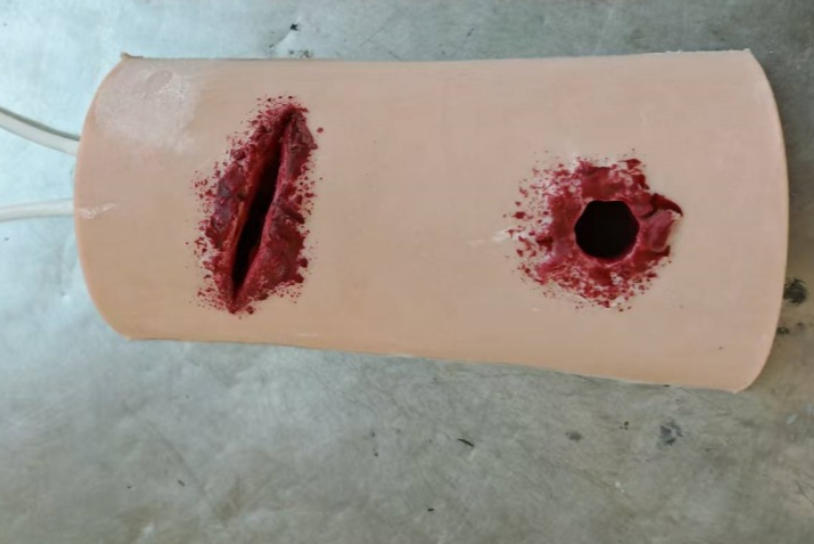
Our War Trauma Medical Model represents the culmination of extensive research into the mechanical properties of human tissue and the specific needs of combat casualty care training.
Substantial Dimensions for Realistic Practice
Measuring 200mm in length, 100mm in width, and an impressive 50mm in thickness, our module provides the depth necessary for comprehensive wound management training. This 5cm profile allows practitioners to:
- Explore deep wound tracks with instruments or gloved fingers
- Practice wound packing techniques requiring substantial tissue displacement
- Simulate the application of hemostatic gauze into deep cavities
- Develop tactile sensitivity for locating bleeding points within tissue
Premium Material Construction
The module is crafted from high-quality silicone, a material choice validated by military medical research for its ability to simulate human tissue properties. Recent advances in surgical simulation have demonstrated that silicone-based models, when properly engineered, can provide realistic haptic feedback essential for skill development.
Our silicone formulation offers distinct advantages:
- Tactile Authenticity: Calibrated to approximate the resistance and elasticity of human soft tissue
- Durability: Engineered to withstand repeated instrument passes and aggressive packing without tearing
- Self-Sealing Properties: Maintains integrity through hundreds of training sessions
- Easy Cleaning: Non-porous surface facilitates decontamination between uses
Customizable Wound Configuration
The true power of our trauma module lies in its customizability. Unlike fixed-configuration manikins that limit training to pre-determined scenarios, our model can be manufactured with any wound type you specify:
- Gunshot Wounds: Simulated entry and exit wounds with track through tissue
- Knife Injuries: Slash wounds, stab wounds with varying depth and angle
- Shrapnel Lacerations: Irregular wounds mimicking fragmentation injuries
- Perforating Trauma: Through-and-through injuries requiring management of both entry and exit
- Avulsion Injuries: Tissue defects with irregular margins
- Crush Injuries: Compressive trauma with tissue disruption
This customizability ensures that your training program can evolve with emerging threats and changing tactical scenarios.
The Science of Simulation: Why Silicone Succeeds
Recent advances in military medical simulation have demonstrated the effectiveness of silicone-based models for trauma training. The development of novel surgical anatomy models for the Military Operational Specialist Team Training (MOSTT) course, designed to bridge the gap between civilian practice and deployed environments, has shown that well-designed silicone models “look and feel as realistic as possible, with the added dimension of pulsatile ‘blood’ flow”.
Validated by Research
Studies involving 90 surgeons and perioperative practitioners have demonstrated that high-fidelity surgical anatomy models add significant value to pre-deployment trauma training -1. Feedback analysis from these trials has been used for iterative model development, confirming that realistic simulation enhances skill acquisition and retention.
The Tactile Advantage
One of the most critical aspects of trauma training is developing the tactile sensitivity necessary for wound assessment and intervention. As one military surgeon noted about high-fidelity simulation: “When the scalpel cuts through the ‘skin’ and ‘blood’ flows out, the surgical feel is incredibly realistic” -9. Our silicone formulation is specifically engineered to provide this authentic haptic feedback.
The Repeatability Factor
Unlike cadaveric tissue or live animal models, which can be used only once or a limited number of times, silicone simulators enable repeated practice on identical wound configurations. This repeatability is essential for deliberate practice—the focused, repetitive rehearsal of specific skills that leads to mastery. Trainees can attempt wound packing techniques dozens of times, refining their approach with each attempt, without the logistical burden of procuring new tissue.
Training Applications: From Point of Injury to Surgical Intervention

The [silic0ne] War Trauma Module supports a comprehensive range of training objectives across the casualty care continuum.
Tactical Field Care
For medics and combat lifesavers operating at the point of injury, the module enables practice of:
- Rapid wound assessment and classification
- Hemostatic gauze packing into deep wound tracks
- Pressure dressing application
- Tourniquet placement for junctional injuries (in appropriate wound configurations)
- Wound re-assessment after initial intervention
Surgical Skills
For forward surgical teams and military surgeons, the module supports:
- Wound exploration and debridement
- Identification of bleeding points within wound tracks
- Vessel ligation simulation (when configured with simulated vasculature)
- Tissue approximation and closure techniques
- Damage control surgery principles
Mass Casualty Triage
In mass casualty scenarios, where multiple wounded present simultaneously, the module can be used to:
- Train rapid triage based on wound severity
- Practice prioritization of interventions
- Simulate the chaos of multiple simultaneous casualties
- Develop team coordination and communication
Validation of Performance
Research has demonstrated that high-fidelity simulators can distinguish between expert and novice performance, with experts achieving bleeding control significantly faster than novices. This capability makes our module suitable not only for training but also for competency assessment and skills verification.
Customization: Your Scenarios, Your Specifications

Every training program has unique requirements. The types of wounds encountered in conventional warfare differ from those in counter-insurgency operations. Urban combat produces different injury patterns than open-field engagements. Your training scenarios should reflect your operational reality.
Our Custom Manufacturing Capability
As a specialized manufacturer of silicone medical training aids, we offer comprehensive customization services:
- Wound Configuration: Specify the exact wound types—gunshot, knife, shrapnel, avulsion, crush—that match your training objectives
- Wound Geometry: Define depth, width, track configuration, and entry/exit characteristics
- Multiple Wounds: Create modules with multiple injury sites for complex scenario training
- Bleeding Simulation: Incorporate channels for simulated blood flow (pulsatile or continuous)
- Anatomical Context: Integrate bone-like structures for fractures, or vessel analogs for vascular injury training
- Size Variations: Adjust the 200*100*50mm dimensions to suit specific training needs
Send Us Your Specifications
Whether you have detailed technical drawings, reference photos of actual injuries, or simply a verbal description of your training requirements, our experienced team can translate your vision into reality. We welcome sample submissions—send us your existing training aids or reference materials, and we will develop a custom solution that meets your exact specifications.
The Export Advantage: Quality for Global Military and Civilian Markets

As a manufacturer committed to serving the international trauma training community, we design every product with the requirements of global distribution in mind.
Medical-Grade Manufacturing Standards
While our trauma modules are classified as training aids, they are manufactured with the rigor typically reserved for medical devices:
- Material Traceability: Every batch of silicone can be traced to its source
- Process Validation: Manufacturing processes are monitored to ensure consistent quality
- Dimensional Accuracy: Each module meets specified measurements within tight tolerances
- Quality Control: Visual and functional inspection before packaging
Packaging for Protection and Efficiency
Each module is carefully packaged to ensure arrival in pristine condition:
- Individual Protection: Modules are secured to prevent damage during transit
- Master Carton Configuration: Optimized for freight efficiency (dimensions: 240*130*50mm per unit; 4500g weight per module)
- Durable Construction: Packaging designed for international shipping rigors
Regulatory Support for Distributors
For international partners, we provide comprehensive technical documentation:
- Material safety data sheets (MSDS) confirming silicone composition
- Product specification sheets with detailed dimensions and properties
- Customs documentation support
- Declaration of conformity for regulated markets
Why Trauma Simulation Matters Now

The global security environment has heightened the urgency of realistic trauma training. Lessons from Ukraine demonstrate that modern warfare produces wound patterns requiring specific skills in hemorrhage control, wound packing, and damage control resuscitation.
The Evidence for Simulation
Recent publications in military medicine have validated the importance of high-fidelity simulation for trauma training. The development and validation of the Repeatable Exsanguination Simulator Using Live Tissue (RESULT) demonstrated that realistic simulators provide training value equivalent to live tissue models, without the ethical and logistical complexities. Participants rated high-fidelity simulators as more realistic, more challenging, and providing more valuable training experiences compared to lower-fidelity alternatives .
Bridging the Civilian-Military Gap
For military medical personnel who spend most of their careers in civilian practice, maintaining trauma skills requires deliberate practice on realistic simulators. Our modules enable this skill sustainment, ensuring that when deployment comes, skills are ready.
Disaster Preparedness
Beyond military applications, mass casualty events—natural disasters, terrorist attacks, industrial accidents—demand that civilian emergency responders possess trauma management skills. Our modules support training for these scenarios as well.
Building a Partnership for Global Trauma Training
At [silic0ne] , we view ourselves not merely as manufacturers but as partners in the global mission to improve trauma care and save lives. Every product we develop is informed by direct feedback from military medics, combat surgeons, emergency physicians, and trauma educators.
Support for Distributors
We provide our distribution partners with comprehensive support:
- Technical Documentation: Material specifications, safety data sheets, and compliance files
- Marketing Materials: Product imagery, specification sheets, and application guides
- Customization Consultation: Assistance in translating training requirements into product specifications
- Volume Pricing: Attractive terms for bulk orders and long-term partnerships
Custom Manufacturing Expertise
Our core competency is transforming concepts into silicone reality. Whether you need:
- Modifications to existing designs
- Entirely new products developed from your specifications
- Private labeling for your brand
- Custom packaging solutions
- Multiple wound configurations in single modules
Our experienced team is ready to bring your vision to reality. Simply send us your samples or specifications, and we will handle the rest.
The Future of Trauma Training
As weapon systems evolve and injury patterns change, trauma training must adapt. The modular, customizable approach embodied by our War Trauma Medical Model represents the future of simulation-based medical education—flexible enough to address emerging threats, realistic enough to develop critical skills, and durable enough to support repeated practice.
For the combat medic preparing for deployment, for the forward surgical team rehearsing damage control procedures, for the emergency physician maintaining trauma readiness, for the military training command seeking to enhance pre-deployment preparation—this module delivers the practice necessary for confidence, competence, and optimal casualty outcomes.
Conclusion
In trauma care, there is no substitute for hands-on experience. Yet the realities of modern conflict, ethical considerations, and logistical constraints demand that we maximize the value of every training opportunity. High-fidelity simulation, supported by well-designed, realistic training tools, is the essential bridge between classroom theory and clinical reality.
The [silic0ne] brand stands for quality, realism, and global readiness. Our War Trauma Medical Model, with its substantial dimensions, customizable wound configurations, and premium silicone construction, offers military and civilian training programs a product that meets the rigorous demands of modern trauma education.
Whether you supply military medical training centers in Europe, combat support hospitals in North America, or emergency response programs across Asia, this module delivers the performance your customers demand and the compliance your business requires.
Real wounds, realistic training, real readiness. Contact [silic0ne] today to discuss wholesale partnerships, customization options for gunshot, knife, and shrapnel wound configurations, and how our custom manufacturing capabilities can support your success in the global trauma training market. Send us your samples or specifications—we will create the training tool you need. Volume discounts available for qualified partners.
Contact me for custom procurement.:silicone@silic0ne.com