购物车里没有产品。
 fuyuhuaxue@iumrs.com
High gloss is easy to achieve indoors. Any competent formulator can produce a mirror-finish coating that looks spectacular in a showroom, reflects the lighting design beautifully, and photographs like polished stone — as long as it never leaves the building. Take that same coating outside, expose it to rain, ultraviolet light, thermal cycling, and grit tracked across the surface, and the gloss begins to dull, the color drifts, and the surface that looked like marble starts to look like a maintenance problem.
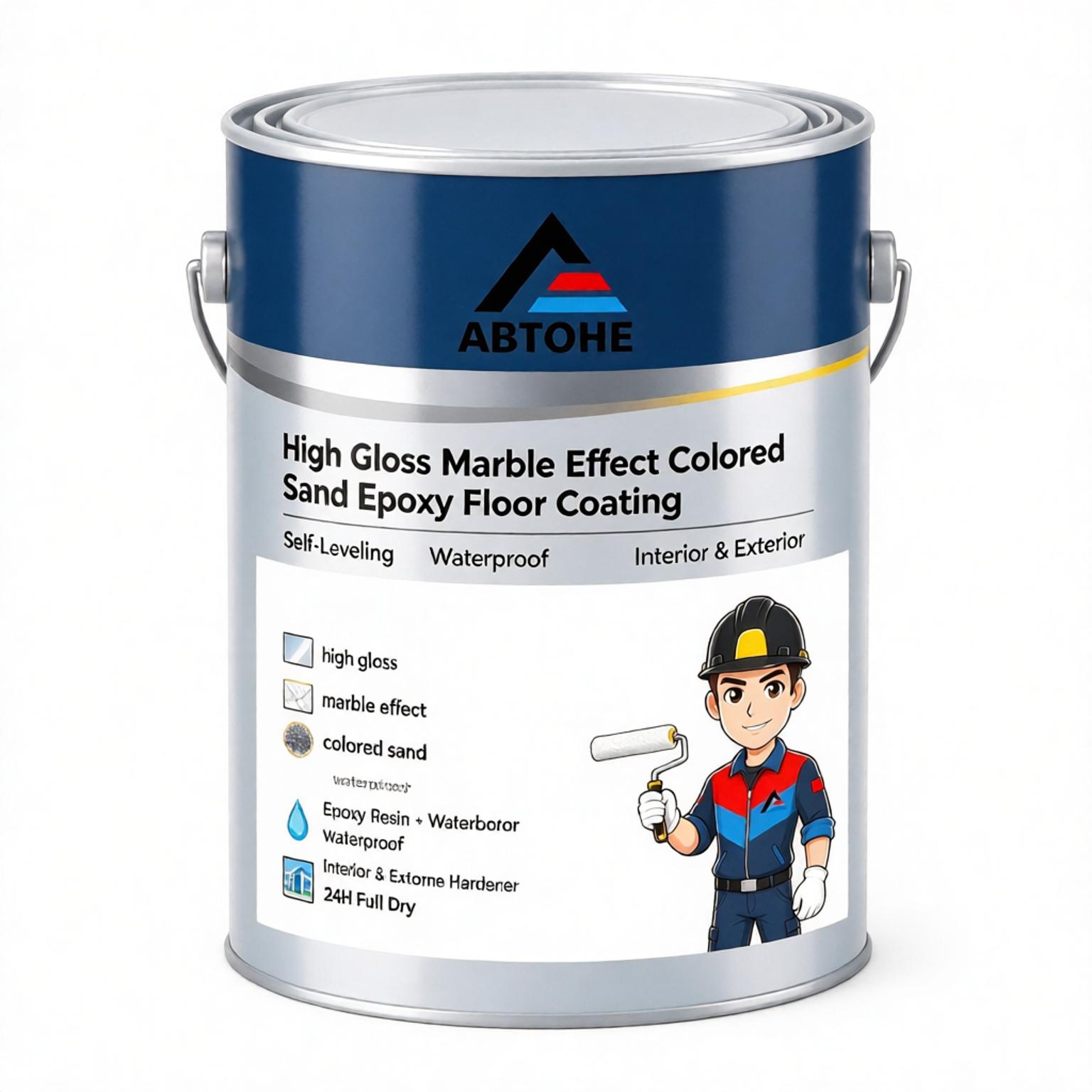
That trade-off — shine indoors, survival outdoors — has shaped the flooring market for years. It is also the trade-off that ABTOHE’s High Gloss Marble Effect Epoxy Floor Coating, model EFP, was formulated to challenge. This is a colored-sand epoxy floor paint built on epoxy resin and a waterborne hardener, supplied as a liquid flowing coating, applicable by brush, specified for both outdoor and indoor use, and finished to a high-gloss marble effect that holds its appearance rather than surrendering it to the first season of weather. It is, in practical terms, a single system for both sides of the building envelope — and that is a more useful proposition than it first appears.
What “Marble Effect” Actually Requires
The marble-effect category has become crowded with products that produce a stone-like appearance through surface pigments or printed films. They look convincing on the day of installation and reveal their construction within a year, because the visual effect sits on top of the coating rather than within it.
ABTOHE’s EFP system takes the colored-sand route. The product is supplied as an epoxy floor paint with color sand — the color is carried by graded aggregate distributed through the epoxy matrix, and the self-leveling behavior allows the material to flow and level into a continuous film with a flat, seamless surface. The marble effect emerges from the depth and variation of the aggregate within the gloss film, not from a decorative layer applied afterward. That distinction determines how the floor ages. A surface-pigmented floor loses its pattern as the top layer wears; a colored-sand floor wears through the color gradually and evenly, because the color is present throughout the wear layer.
The high-gloss finish is the second half of the effect. Gloss is what gives a marble surface its sense of depth — the way light travels across the film and reflects the room. In a colored-sand epoxy system, achieving that gloss requires a formulation that levels smoothly, releases air cleanly, and cures to a dense, non-porous surface. The EFP system is described as a liquid flowing coating, which is the physical property that allows it to self-level into a uniform film and produce the continuous reflective surface that the marble effect depends on.
The Brush Application Question: Accessibility Without Compromise
The specification lists brush application as the method, and that deserves a direct explanation because it is one of the system’s most practical features.
Most high-build epoxy floors are applied with squeegees, trowels, or spray equipment — tools that require trained operators, mobilization cost, and scheduling dependencies. For a residential garage, a retail unit, a courtyard, or a small commercial floor, that equipment burden can exceed the material cost and push the project toward a cheaper, less durable alternative.
ABTOHE’s EFP system is designed for brush application. The liquid flowing consistency allows the material to be worked across the surface with a brush, leveling into a continuous film as it cures. For detail work — edges, thresholds, around equipment, stair nosings, wall junctions — brush application is not a compromise but an advantage, because it gives the applicator control where a pour would simply run. For broader areas, the same flowing property supports roller application, and the self-leveling behavior helps the film even out as it sets.
The result is a system that a competent contractor, maintenance team, or skilled DIY renovator can apply without specialized equipment — while still delivering the high-gloss, seamless, marble-effect finish that the category promises. Accessibility, in other words, without downgrading the chemistry.
The Waterborne Hardener: Why This Matters Indoors and Outdoors
The material composition — epoxy resin plus waterborne hardener — is the detail that explains much of the system’s behavior, and it is worth unpacking because it drives both the environmental profile and the application flexibility.
Traditional epoxy systems use solvent-based or solvent-free hardeners that can produce strong odor during application, require ventilation, and limit use in occupied buildings. A waterborne hardener reduces that burden substantially: lower odor, lower VOC profile, and a formulation that can be applied in spaces that cannot be evacuated for days. For residential interiors, retail units, offices, and hospitality spaces, that is the difference between a project that gets scheduled and one that keeps getting postponed.
The waterborne chemistry also supports the outdoor specification. A properly formulated waterborne epoxy cures to a film with adhesion, water resistance, and weathering tolerance — properties that matter when the floor is exposed to rain, temperature swings, and surface moisture. The system is specified for outdoor and indoor use, and the waterborne hardener is central to that dual capability. It also contributes to the eco-friendly positioning that increasingly appears in project requirements, particularly in green-building and health-focused specifications.
For buyers, the practical takeaway is straightforward: a lower-odor, waterborne-hardener epoxy that can be applied in occupied buildings, used on exterior surfaces, and cured to a high-gloss decorative finish is a rare combination. Most systems optimize for one environment. This one is specified for both.
Interior Performance: Where Gloss Sells the Space
Indoors, the value of a high-gloss marble-effect floor is partly visual and partly operational.
Visually, a continuous, reflective floor changes how a room reads. It amplifies lighting, extends the perception of space, and gives the interior a finished quality that tile or laminate cannot match because there are no grout lines or seams to break the plane. In showrooms, retail environments, lobbies, restaurants, and residential living areas, the floor becomes part of the design rather than a default surface beneath it.
Operationally, the seamless epoxy film delivers the properties that interior spaces actually need: waterproofing, wear resistance, and easy cleaning. A continuous surface has nowhere for soil to collect and no porous areas to absorb spills. Cleaning is faster and more effective, which matters in commercial interiors where housekeeping labor is a recurring cost. For kitchens, utility areas, and bathrooms, the waterproof barrier protects the substrate from moisture damage. For garages and basements, it resists oil, fuel, and moisture while providing a cleanable, dust-free surface.
The customizable color capability extends the interior value further. The system can be specified in a palette matched to cabinetry, brand identity, or architectural finishes, allowing a single product platform to serve multiple rooms and zones with visual continuity.
Exterior Performance: The Harder Test
Exterior exposure is where decorative epoxy systems usually fail, and where the EFP specification is most distinctive. Rain, ultraviolet light, thermal expansion and contraction, and airborne grit all attack a coating simultaneously. Gloss dulls. Color drifts. Films that were flexible in a climate-controlled room become brittle in a freeze-thaw cycle.
ABTOHE’s system is specified for outdoor use, and the waterborne hardener plus colored-sand construction provides a credible basis for that claim. The aggregate-reinforced film resists abrasion from foot traffic and surface grit. The continuous epoxy matrix resists water penetration, protecting the substrate beneath. The color is carried within the film rather than applied as a surface layer, so it does not wear away at the first sign of traffic. The gloss finish is formulated for exterior durability, and the platform’s usage classification — building coating and road marking paint — signals that the chemistry is expected to tolerate exterior exposure and traffic rather than merely survive a covered porch.
A specifier’s note is warranted here, because honest technical guidance builds more trust than an unconditional claim. For prolonged direct-sun exposure in high-UV climates, the prudent specification is to pair the system with a UV-stable topcoat where maximum long-term gloss and color retention are required. That is standard practice for exterior epoxy installations and does not diminish the system’s value — it simply reflects the reality that UV exposure is the hardest condition any polymer film faces. Used on covered walkways, courtyards, patios, driveways, exterior stairs, and building perimeters, the system delivers the high-gloss marble effect with the wear and water resistance that exterior surfaces demand.
The Schedule Math: 24-Hour Full Cure and 24-Month Shelf Life
Two numbers in the specification determine whether the product is practical for real projects, and both are unusually favorable.
Completely dry in 24 hours. For contractors, that is a return-to-service timeline measured in a single day rather than a week. For facility owners, it means a weekend installation can be back in service by Monday. For residential clients, it means the disruption is short enough to be tolerable. In commercial settings where closure is expensive, the cure window is often the deciding factor in the specification, and a 24-hour full cure is a genuine competitive advantage.
Shelf life of 24 months. Two years of storage stability matters for distributors holding inventory, contractors buying material for phased projects, and facility teams stocking coating for touch-ups and repairs. Many waterborne epoxies lose reactivity or settle well before that window. A 24-month shelf life, when stored in a cool dry place as specified, reduces waste and supports project planning across seasons.
Packaging, MOQ, and Supply Chain Practicalities
The system is supplied in 20 kg units, with a single package size of 30 × 30 × 37 cm and a single gross weight of 20.0 kg — a contractor-friendly unit that can be handled, mixed, and applied without lifting equipment. Customized packaging is available, which supports private-label and distributor programs. The minimum order quantity is 50 pcs, a project-scale threshold suitable for contractors, distributors, and multi-site programs rather than single-room retail purchase.
ABTOHE manufactures the EFP system in Anhui, China, a province with established chemical and coatings production infrastructure and logistics connections to export markets. The product carries the identifiers that procurement teams require — CAS, EINECS, and molecular formula are listed as mixtures, reflecting the multi-component nature of a formulated epoxy system — and the material composition, weight, shelf life, and drying time are all documented in the specification. That level of disclosure matters for import compliance, project submittals, and material safety review.
One System, Both Sides of the Envelope
The old assumption was that a floor could be beautiful or durable, indoor-grade or outdoor-grade, decorative or industrial. ABTOHE’s High Gloss Marble Effect Epoxy Floor Coating rejects that framing. It is a colored-sand epoxy system with a waterborne hardener, applied by brush, self-leveling into a seamless high-gloss film, specified for interior and exterior use, fully cured in 24 hours, and shelf-stable for 24 months.
For the homeowner, it is a floor that looks like stone and behaves like a coating — in the kitchen, the garage, the patio, and the courtyard. For the contractor, it is a system that applies with familiar tools and returns the space to service in a day. For the distributor, it is a product with customized packaging, a workable MOQ, and a specification sheet that answers the questions buyers actually ask.
Marble has always been the benchmark for a floor worth noticing. It has also always been the benchmark for a floor that needs protecting. This system delivers the first without inheriting the second — high gloss that survives the weather, color that lives inside the film, and a surface that keeps looking like the day it was installed, indoors and out.