 fuyuhuaxue@iumrs.com
Every failed industrial floor tells the same story in reverse. The topcoat gets the blame—it’s the surface that peels, blisters, or lifts under a forklift wheel. But if you strip that story back to its origin, you almost always arrive at the same culprit: the bond between coating and concrete was never strong enough to begin with.
The topcoat can be premium. The color coat can be flawless. The finish can be gorgeous. None of it matters if the primer underneath doesn’t hold. A floor coating is a stack of commitments, and the primer is the first one—the handshake between chemistry and concrete. If that handshake fails, everything above it is living on borrowed time.
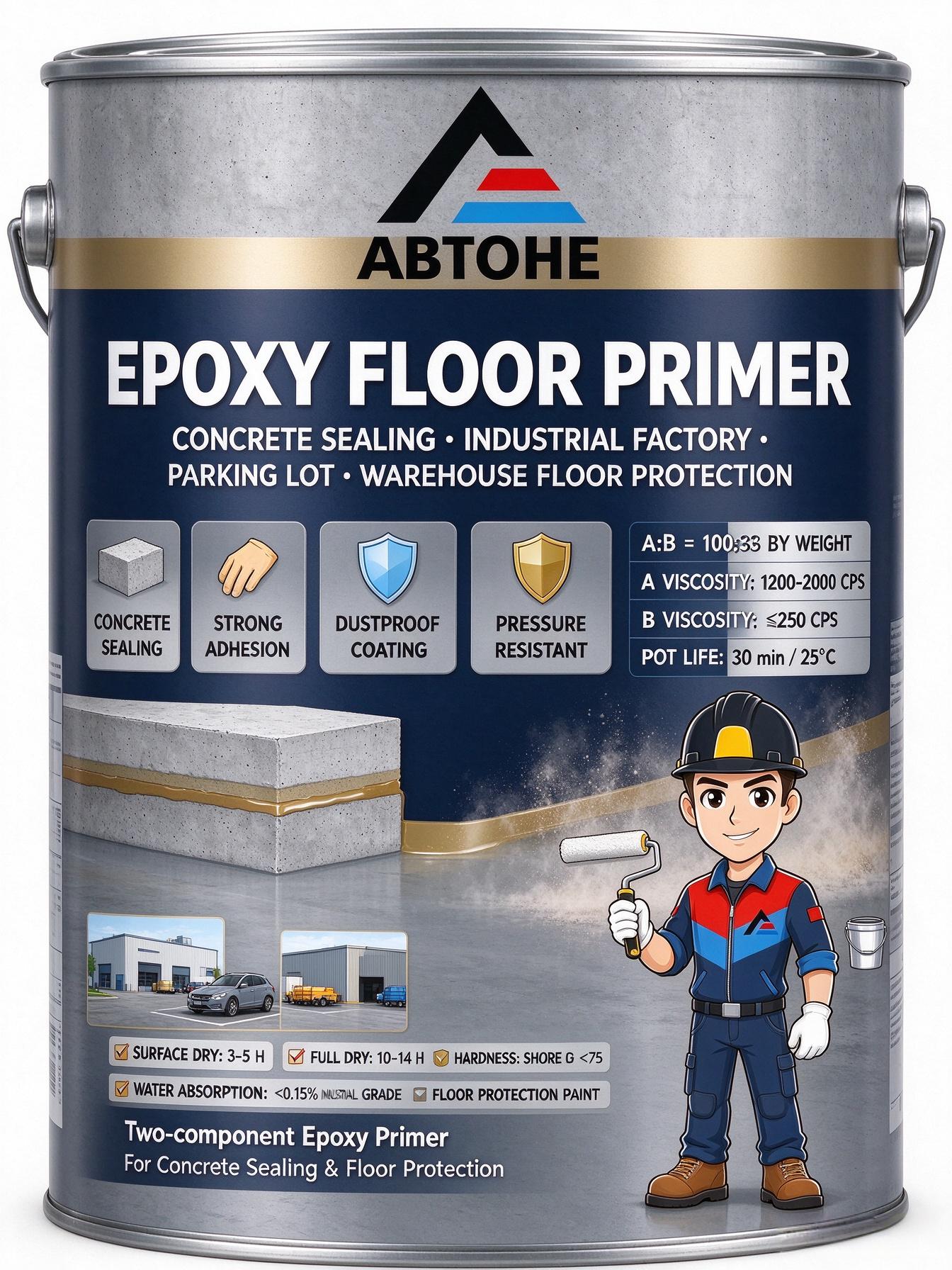
That’s why epoxy floor primers deserve far more attention than they typically get, and it’s why the B2 Epoxy Floor Primer is worth examining closely. It’s an industrial-grade concrete sealing and protection primer designed for factories, parking lots, warehouses, and large-scale commercial flooring systems—a base coat engineered with strong adhesion, dustproofing, wear and pressure resistance, and the specific viscosity profile that lets it penetrate concrete and lock in place.
It isn’t glamorous. It’s the reason the glamorous stuff lasts.
Let’s give it the attention it has earned.
Strong Adhesion: The Foundation of Everything Above
The headline specification of any primer is adhesion, and the B2 delivers it where it matters most—between primer and concrete.
Concrete is a porous, alkaline, mineral substrate. Getting a coating to bond to it properly requires a material that can wet the surface, penetrate the pores, and cure into a continuous film that mechanically keys into the slab while forming a chemical grip. If the primer’s viscosity is wrong, it sits on top rather than soaking in. If the chemistry is wrong, it cures too fast to penetrate or too soft to hold.
The B2 primer is formulated with a Part A viscosity of 1200–2000 CPS and a Part B viscosity of ≤250 cps. That relationship matters. Part A is thick enough to build a film and carry fillers, while Part B is thin and mobile. When combined at the specified A:B = 100:33 by weight, the mixture achieves a working viscosity that allows penetration into the concrete surface while still forming a proper film.
The result is a strong, long-lasting bond between primer and concrete—the base that everything else depends on. It’s the difference between a floor coating that survives ten years and one that starts lifting at the edges within a season.
The Mix Ratio: Precision as a Performance Tool
The A:B = 100:33 by weight ratio isn’t an arbitrary number. It’s a precisely calculated stoichiometric balance—enough hardener to fully cross-link the epoxy without leaving unreacted material that softens the film or excess that makes it brittle.
For applicators, that ratio is straightforward to measure by weight, which is the reliable way to mix two-component systems. For project managers, it’s a quality control point: mix it correctly, and the primer behaves as designed. Mix it by guesswork, and the failure shows up months later in the topcoat.
Pot life is 30 minutes at 25°C. That’s a practical working window—long enough to apply a section properly, short enough that you’re not working with material that’s starting to gel. For a primer, which is typically applied quickly with a roller or squeegee, that timing is well matched to the task.
Surface Dry in 3–5 Hours, Full Dry in 10–14 Hours
Primer scheduling is a critical path consideration on any flooring project. If the primer cures too slowly, the whole project stalls. If it cures too fast, you can’t get the next coat down before the surface passes the recoat window.
The B2 primer reaches surface dry in 3–5 hours and full dry in 10–14 hours at typical conditions. That’s a professional-friendly profile: an afternoon application can be ready for the next coat the following morning, which means a two-day flooring project can proceed on schedule rather than stretching into three.
For factory and warehouse projects where every hour of downtime has a cost, that predictability is valuable. For parking lot and commercial work, it means crews aren’t standing around waiting for a primer to cure.
Dustproof Coating: The First Line Against Contamination
Bare concrete dusts. Every footstep, every tire, every sweep lifts fine particles off an unsealed slab, and those particles go everywhere: onto machinery, into products, across finished surfaces, and into the air that workers breathe.
The B2 primer begins the sealing process. As it penetrates and cures, it binds the surface particles in place, reducing dust generation and creating a dustproof coating that protects floors against dust and debris accumulation. It’s not the final word in sealing—that’s what topcoats are for—but it’s the first critical step, and in many industrial settings, it’s the layer that makes the biggest difference to day-to-day cleanliness.
For warehouses, that means fewer complaints about dust on stored goods. For factories, it means reduced contamination risk. For parking lots, it means less grit tracking into adjacent buildings.
Wear Resistant Finish: Engineered for Heavy Machinery
The B2 primer cures to a hardness of Shore D <75—a specification that reflects a considered balance. It’s hard enough to resist wear and support the coats above it, but not so rigid that it becomes brittle or fails to accommodate the movement of the concrete beneath.
That wear resistance matters in the environments this primer was designed for. Heavy machinery impacts, rolling loads, and constant abrasion from forklifts, pallet trucks, and vehicle traffic all test the coating stack. A primer that softens or wears through allows the topcoat to fail from below, which is a repair nobody wants to schedule.
The primer provides durability against heavy machinery impacts and contributes to the long-term performance of the entire flooring system. It’s the layer that absorbs and distributes stress so the layers above don’t have to.
Pressure Resistant Surface: Built for Wash-Down Operations
Many industrial floors are cleaned with high-pressure equipment. Food-adjacent facilities, chemical plants, maintenance bays, and wash-down areas all rely on pressure cleaning to maintain hygiene and remove stubborn contamination.
High-pressure water is brutal on weak coatings. It finds pinholes, lifts edges, and forces moisture beneath the film. A primer that isn’t pressure-resistant becomes the failure point.
The B2 primer enhances resistance to high-pressure cleaning equipment, which means the floor system can withstand the cleaning regime it’s actually subjected to. That’s a practical, real-world specification—one that reflects an understanding of how industrial floors are used rather than how they’re drawn on a specification sheet.
Water Absorption Below 0.15%: The Sealing Performance
Water absorption is one of the clearest indicators of a coating’s sealing quality. The B2 primer’s water absorption is under 0.15%, a figure that confirms the cured film is dense and closed—resisting moisture penetration rather than absorbing it.
That matters for concrete protection. Moisture trapped beneath a coating causes blistering, delamination, and efflorescence. Moisture passing through a coating weakens the bond and degrades the substrate. A low water absorption rate means the primer is doing its job as a sealing layer, protecting the concrete while preparing it for the next coat.
For parking lots exposed to rain and de-icing salts, for warehouses with humidity swings, for factories with wash-down areas—that low absorption figure is meaningful protection.
Industrial Grade: Built for Large-Scale Systems
The B2 primer is specified as industrial grade, suitable for large-scale commercial flooring systems. That designation reflects both its performance and its practical characteristics:
- Consistent, mixable two-component chemistry that scales from a small repair to a full warehouse floor
- Viscosity and pot life suited to efficient application on large areas
- Cure times that fit the scheduling realities of commercial projects
- Performance characteristics that meet the demands of industrial use—wear, pressure, dust, moisture
For contractors, that means a primer that behaves predictably across thousands of square meters. For distributors and project buyers, it means a product that can be specified confidently for large installations.
Where This Primer Belongs
The B2 primer is designed for concrete substrates in demanding environments:
Industrial factories – where machinery, traffic, and contamination control all demand a properly sealed and bonded floor system.
Parking lots and garages – where vehicle traffic, oil, weather, and pressure washing test the entire coating stack.
Warehouses and distribution centers – where forklifts, racking, and heavy storage put constant pressure on the floor.
Commercial and large-scale flooring systems – where the primer is the base for decorative or high-performance topcoats.
Wash-down and maintenance areas – where pressure resistance and low water absorption are essential.
It’s also the right base for any epoxy floor system where the topcoat will be expected to perform—which, properly understood, means every one of them.
The Technical Snapshot
- Product: B2 Epoxy Floor Primer (Epoxy Floorcoating)
- Type: Concrete sealing and protection primer
- Mix Ratio: A:B = 100:33 by weight
- A Viscosity: 1200–2000 CPS
- B Viscosity: ≤250 cps
- Pot Life: 30 minutes at 25°C
- Surface Dry: 3–5 hours
- Full Dry: 10–14 hours
- Hardness: Shore D <75
- Water Absorption: <0.15%
- Key performance: Strong adhesion, dustproof, wear resistant, pressure resistant, industrial grade
- Applications: Factory, parking lot, warehouse, large-scale commercial flooring systems
The Bottom Line
Primers don’t win awards. Nobody photographs a base coat. But the primer is where a flooring project succeeds or fails, and everything else is downstream of that decision.
The B2 Epoxy Floor Primer is built to make that decision easy. It delivers strong adhesion between primer and concrete, a dustproof coating that begins the sealing process, wear resistance against heavy machinery, pressure resistance for high-pressure cleaning, low water absorption for genuine moisture protection, and a viscosity and cure profile that make it practical to apply at scale.
It’s industrial grade, suitable for factories, parking lots, warehouses, and commercial flooring systems of any size. And it does the one thing a primer must do: it holds—so the layers above it can perform as designed.
If you’re planning a floor coating project and treating the primer as an afterthought, this is the product that reminds you why that layer exists. Get it right, and the floor lasts. Skip it, and everything above is a temporary solution.
B2 Epoxy Floor Primer. The bond that makes the floor.