 fuyuhuaxue@iumrs.com
There are two environments where a floor simply cannot be allowed to fail. The first is a parking lot—a vast expanse of concrete subjected to the daily assault of vehicles, oil drips, tire abrasion, weather extremes, and the constant threat of structural deterioration. The second is a hospital—a space where the floor is not merely a walking surface but a critical component of infection control, patient safety, and operational continuity. These two environments could hardly be more different in function and atmosphere, yet they share a common demand: a floor that performs without compromise, day after day, year after year, under conditions that would destroy lesser coatings.
For decades, the flooring industry has struggled to deliver a single solution that meets the needs of both. Parking lots require abrasion resistance, chemical resistance to oils and de-icing salts, and the ability to withstand heavy point loads from vehicles. Hospitals require seamless hygiene, chemical resistance to disinfectants, impact tolerance for gurneys and equipment, and an aesthetic that supports healing and calm. Too often, specifiers have been forced to choose between products optimized for industrial durability and products optimized for healthcare hygiene—accepting compromises in one area to achieve performance in another.
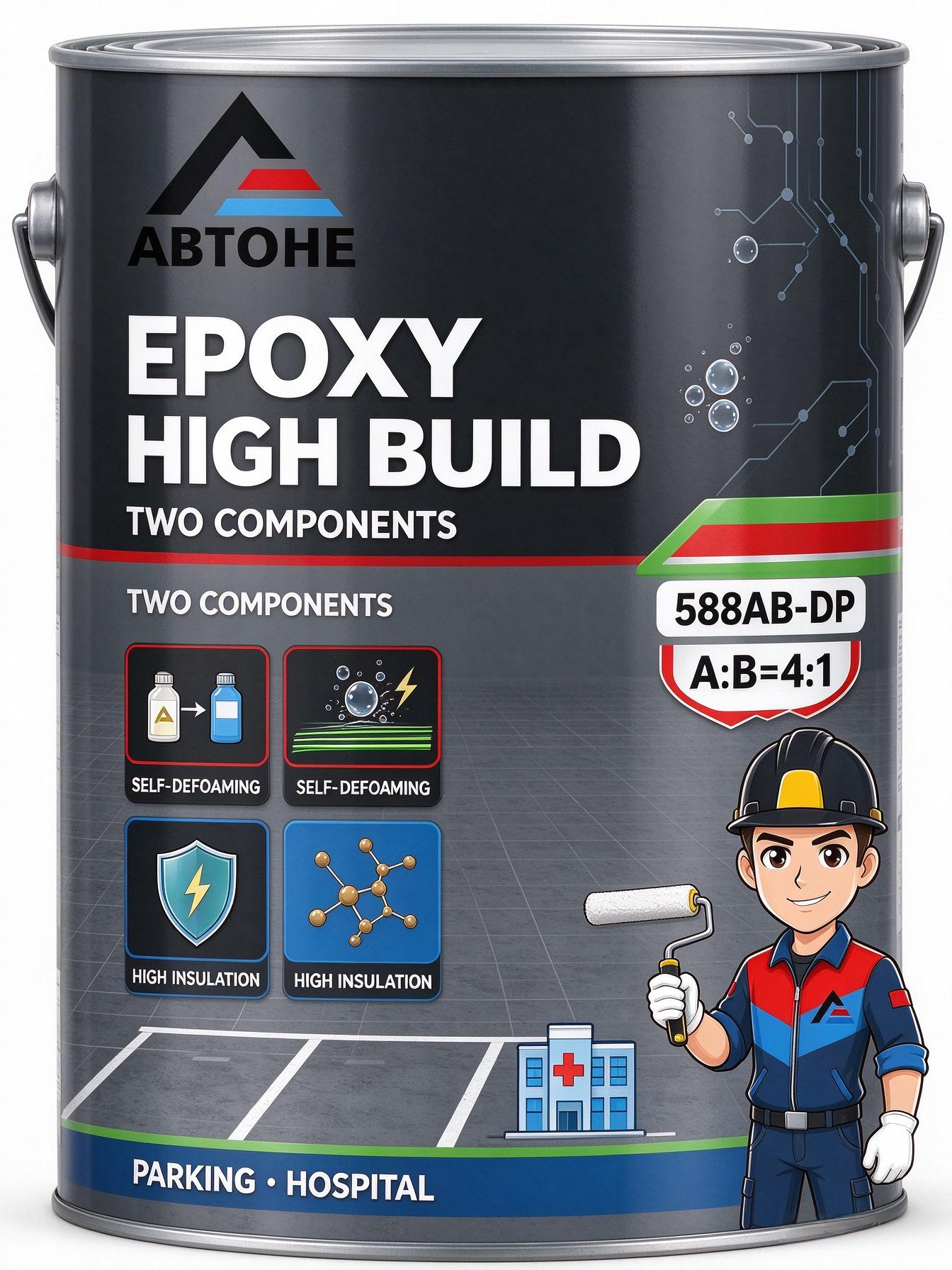
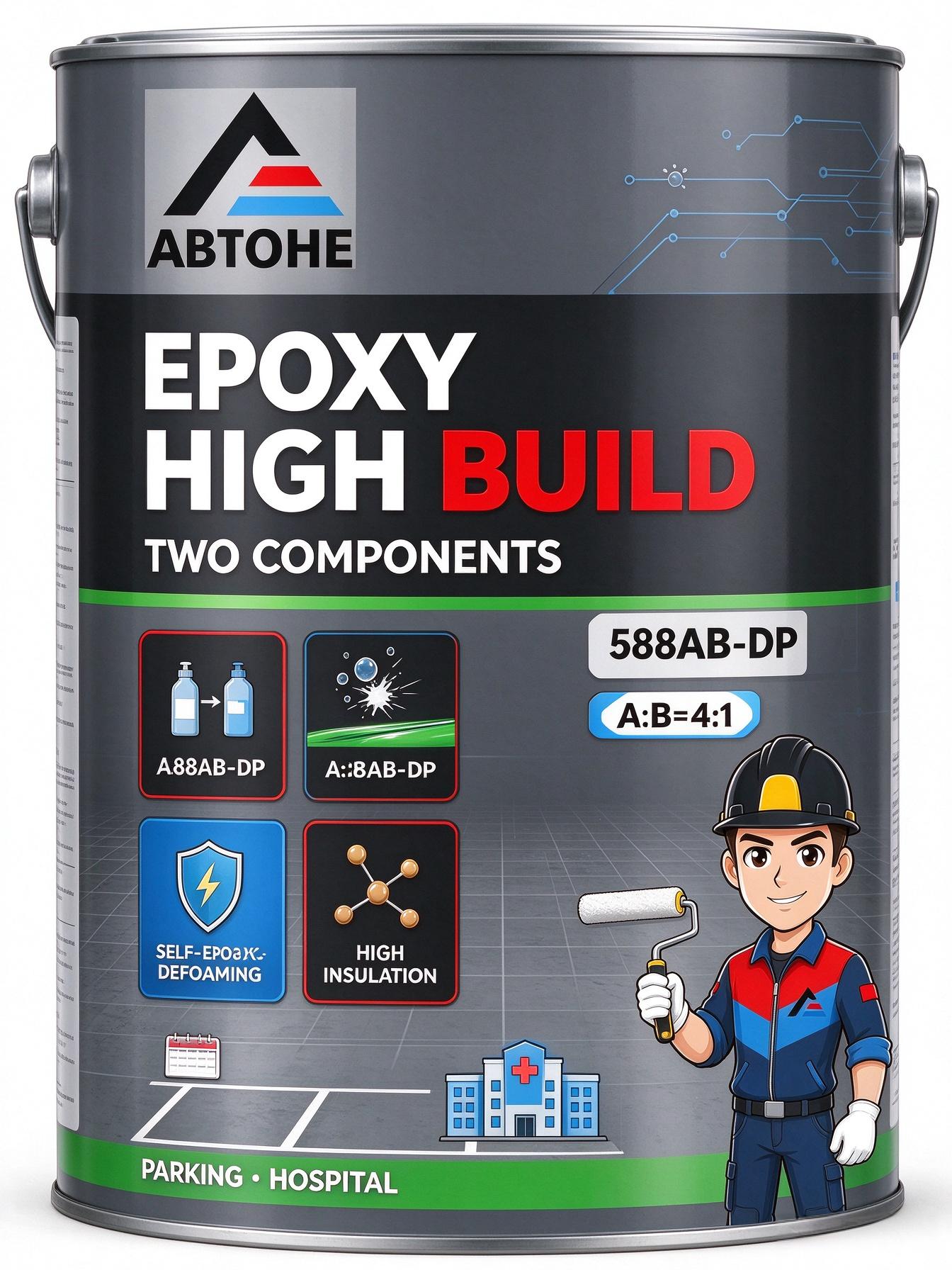
High-build epoxy resin coatings are changing that equation. Formulated as two-component systems with high volume solids, automatic defoaming properties, and exceptional electrical insulation characteristics, these coatings offer a combination of durability, application reliability, and safety performance that spans the full spectrum of demanding environments. Among them, the ABTOHE high-build epoxy floor coating—model 588AB-DP—stands out as a product engineered for the spaces where failure is not an option: parking lots, hospitals, and the critical infrastructure that connects them.
The Chemistry of Confidence: Two-Component Epoxy Resin
At the heart of any high-performance epoxy coating is its chemistry. The ABTOHE 588AB-DP is a two-component epoxy resin system, supplied as Part A resin and Part B hardener in a mixing ratio of 4:1. When combined, the two components react chemically to form a tightly cross-linked thermoset film that bonds tenaciously to concrete substrates and cures to a hard, durable, chemically resistant surface.
This two-component chemistry is what distinguishes high-build epoxy from conventional single-component coatings. Single-component products cure through solvent evaporation or moisture exposure, which limits their film thickness, their chemical resistance, and their long-term durability. Two-component epoxies cure through an irreversible chemical reaction, allowing them to be applied at much greater thicknesses—hence the term “high-build”—and to achieve mechanical and chemical properties that single-component products cannot match.
The practical consequences are significant. A high-build epoxy floor can withstand years of heavy traffic without wearing through. It resists the penetration of oils, solvents, and cleaning chemicals that would degrade thinner coatings. It does not dust or chalk, maintaining a clean, professional appearance. And it bonds firmly to the substrate, reducing the risk of delamination, peeling, and the callbacks that plague contractors and frustrate facility managers.
The mixing ratio of 4:1 is designed for ease of use and consistent results. The shelf life of six months ensures adequate inventory flexibility, and the leading time of three working days supports project schedules that cannot afford delays. The product is manufactured under the EINECS No. 210-898-8 and CAS No. 38891-59-7, with the molecular formula [CH(CH2Cl)CH2O]n—technical details that matter to specifiers who need to verify the chemistry and compliance of the materials they specify.
The Defoaming Advantage: Smooth Application, Professional Results
Anyone who has worked with epoxy coatings knows the frustration of air bubbles. They form during mixing, during pouring, and during application. They rise to the surface and, if not eliminated, create a pitted, uneven finish that looks unprofessional and can compromise the performance of the coating. In high-build applications, where thick films are applied in a single pass, the risk of bubbling is particularly acute—which is why automatic defoaming is such a valuable feature.
The ABTOHE 588AB-DP is formulated with automatic defoaming properties. This means that air bubbles incorporated during mixing and application rise to the surface and break naturally, without the need for manual defoaming tools or specialized equipment. The result is a smooth, consistent finish that looks professional and performs as intended.
For contractors, this simplifies the application process and reduces the risk of defects that require rework. For facility managers, it ensures that the finished floor meets the aesthetic and functional standards of the project. And for specifiers, it provides confidence that the product will deliver consistent results across different applicators and site conditions.
The automatic defoaming feature is particularly important in high-build applications, where the thickness of the film makes bubble elimination more challenging. By addressing this challenge at the formulation level, ABTOHE has created a product that is easier to use and more reliable in its outcomes—a combination that benefits everyone from the applicator to the end user.
High Volume Resistivity: Safety in High-Voltage Environments
One of the most distinctive attributes of the ABTOHE 588AB-DP is its high volume resistivity—1×10^15 Ohm·cm. This property provides excellent electrical insulation, making the coating ideal for environments where electrical safety is a concern.
In hospitals, this is particularly relevant. Medical equipment, imaging systems, and operating room technologies all rely on electrical systems that must be protected from static discharge and ground faults. A floor with high volume resistivity helps to dissipate static electricity safely and provides an additional layer of protection against electrical hazards. In parking lots, where electric vehicle charging stations are increasingly common, the electrical insulation properties of the coating contribute to the safety of the infrastructure.
The high volume resistivity also makes the coating suitable for specialized environments such as electronics manufacturing facilities, data centers, and laboratories, where static discharge can damage sensitive equipment and compromise processes. While the primary applications for this product are parking lots and hospitals, the electrical properties extend its usefulness to any environment where electrical safety and static control are important.
For specifiers, the 1×10^15 Ohm·cm volume resistivity is a measurable performance characteristic that can be verified through testing and specified with confidence. It is not a marketing claim; it is a technical property that reflects the quality of the formulation and the care with which the product has been engineered.
Parking Lots: The Battle Against Wear and Weather
A parking lot is a harsh environment. Vehicles arrive hot and leave oil drips. Tires abrade the surface with every turn. De-icing salts attack the concrete during winter. Rain, snow, and UV radiation degrade unprotected surfaces. Over time, a poorly protected parking lot develops cracks, spalls, and stains that require costly repairs and undermine the appearance of the property.
The ABTOHE high-build epoxy coating is engineered for this environment. The two-component chemistry provides the abrasion resistance needed to withstand constant tire traffic. The high-build film thickness ensures that the coating does not wear through quickly, extending the service life of the floor. The chemical resistance protects against oils, gasoline, and de-icing salts. And the seamless, non-porous surface prevents water penetration and simplifies cleaning.
The coating is suitable for both interior and exterior parking applications. In covered garages, it provides a durable, easy-to-clean surface that resists tire marks and oil stains. In open lots, it can be formulated for UV stability and weather resistance, protecting the concrete from the elements and maintaining the appearance of the property. For property owners and facility managers, this translates into lower maintenance costs, fewer repairs, and a parking facility that remains safe and presentable throughout its service life.
The high volume resistivity adds another dimension to the product’s suitability for parking lots. As electric vehicles become more common, the electrical safety of parking infrastructure becomes increasingly important. A floor with high electrical insulation properties contributes to the overall safety of the facility and supports the integration of EV charging infrastructure.
Hospitals: Hygiene, Safety, and the Healing Environment
In a hospital, the floor is part of the care environment. It must be seamless and non-porous to support infection control. It must be impact-resistant to withstand the constant traffic of gurneys, wheelchairs, and medical equipment. It must be chemical-resistant to withstand the disinfectants that are used to clean and sanitize the space. And it must be aesthetically appropriate—calm, clean, and supportive of the healing process.
The ABTOHE high-build epoxy coating meets these demands. The seamless, high-build film covers the entire floor area without joints, grout lines, or seams that can harbor bacteria. The surface is dense and non-porous, resisting stain and chemical penetration and allowing thorough cleaning with standard hospital disinfectants. The impact resistance protects the floor from the constant percussion of medical equipment, and the wear resistance ensures that the floor maintains its appearance over years of heavy use.
The high volume resistivity is particularly valuable in hospital environments where electrical safety is paramount. Operating rooms, imaging suites, and intensive care units all rely on sophisticated electrical equipment that must be protected from static discharge and ground faults. A floor with high electrical insulation properties provides an additional layer of safety for patients and staff.
The automatic defoaming feature ensures a smooth, professional finish that supports the hospital’s visual standards. A floor that looks clean and well-maintained reinforces patient confidence and contributes to the sense of a well-run facility. And the two-component chemistry provides the durability that hospital administrators need to control maintenance costs and avoid disruptive repairs.
Versatility Beyond the Primary Applications
While the ABTOHE 588AB-DP is positioned for parking lots and hospitals, its performance characteristics make it suitable for a much broader range of applications. The high-build epoxy chemistry provides the durability needed for warehouses, industrial workshops, and manufacturing facilities. The chemical resistance makes it suitable for food processing plants, laboratories, and cleanrooms. The electrical insulation properties extend its usefulness to electronics manufacturing, data centers, and specialized industrial environments. And the automatic defoaming feature simplifies application in any environment where a smooth, professional finish is required.
The product is classified as a double-component adhesive and is suitable for use in construction, fiber and garment, footwear and leather, packing, transportation, and woodworking applications—a reflection of the versatility of the epoxy chemistry. The clear color and customizable finish options allow the coating to be adapted to different aesthetic requirements, from industrial gray to custom color matching for healthcare or commercial environments.
Packaging and Practicality
The ABTOHE 588AB-DP is supplied in a range of packaging formats to suit different project sizes and logistics requirements. The product is available in 5 kg bottles, 20 kg cartons, 20 kg barrels, and 200 kg barrels, with a single package size of 18×6×6 cm and a gross weight of 0.3 kg for the smallest unit. The port of dispatch is Shenzhen, China, providing access to global shipping routes and supporting international distribution.
The shelf life of six months and the leading time of three working days support project schedules and inventory management. For contractors and distributors, this means reliable availability and predictable lead times—critical factors in an industry where delays can cascade into significant costs.
The Bottom Line: A Floor Engineered for the Real World
The ABTOHE high-build epoxy floor coating is not simply a product. It is a solution engineered for the environments where failure is not an option. Its two-component chemistry ensures strong adhesion and durability. Its automatic defoaming feature simplifies application and ensures a smooth, professional finish. Its high volume resistivity provides electrical insulation for high-voltage environments. And its versatility makes it suitable for parking lots, hospitals, warehouses, industrial facilities, and beyond.
For specifiers, contractors, and facility managers, the appeal is straightforward: a coating that performs under pressure, applies with confidence, and delivers long-term value across the full spectrum of demanding environments. In a market where flooring decisions are too often a compromise between performance and practicality, the ABTOHE 588AB-DP is a rare thing—a product that refuses to choose. It is, in every sense, a floor that refuses to fail. And in the spaces where modern life happens—the hospitals where we heal and the parking lots where we arrive—that is exactly the kind of reliability the world needs.