 silicone@silic0ne.com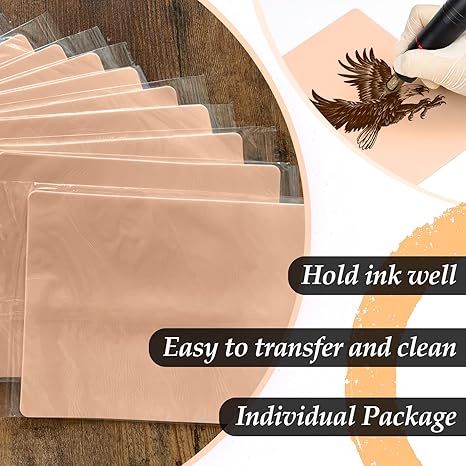
There is a moment in every tattoo artist’s journey when they realize that cheap practice skins are holding them back.
The needle skips because the surface is too slick. The fake skin tears because it is too brittle. The ink pools in ugly blobs because the material has no texture. And when you try to wrap it around a curved surface to practice tattooing a forearm or a calf, it cracks or refuses to stay in place.
You start to wonder: Is this really preparing me for real skin?
The answer is no. Not if you are practicing on standard 1.0mm rubber pads or flimsy vinyl sheets. You need something that feels, behaves, and responds like the real thing.
Enter the 10Pcs Tattoo Fake Skin Double‑Sided Silicone Practice Skins from Yuelong. At 1.3mm thick – thicker than most practice skins – and made from high‑grade silicone with true skin‑like elasticity, these 7.4”×5.6” sheets are designed to bridge the gap between artificial practice and living tissue.
Whether you are learning microblading hairlines, practicing eyeliner gradients, or drilling tattoo shading and outlining, these skins offer a realistic, durable, and versatile canvas. And with 10 individually wrapped double‑sided sheets, you have twenty practice surfaces to perfect your craft.
Let’s dive into why this set is the smartest investment you can make in your tattooing education.

Part One: Premium Practice Package – 10 Individually Wrapped Double‑Sided Skins
Let’s start with what you actually get.
10 pieces of tattoo practice skin, each measuring 7.4 inches by 5.6 inches – a generous canvas that fits comfortably in your hand while offering enough space for multiple small designs or one detailed piece.
1.3mm thickness – this is significantly thicker than the standard 1.0mm practice skins found on many platforms. Why does thickness matter? Because it allows for double‑sided reusability. You can practice on one side, flip the sheet over, and practice on the other without worrying about needle blow‑through or distortion. The extra 0.3mm of silicone provides structural integrity, so your lines on side A do not affect your work on side B.
Individually wrapped – each skin comes in its own sealed package. This is a small detail with big benefits. It keeps the skins clean, dust‑free, and protected from light and moisture. You can open one sheet at a time, leaving the others pristine for future practice sessions. If you are a traveling artist, you can toss a few sealed sheets into your kit without worrying about them getting scratched or dirty.
Blank double‑sided surfaces – both sides are completely blank. No distracting logos, no pre‑printed lines, no wasted space. You have total freedom to draw your own stencils, practice freehand, or use transfer paper. The blank canvas also means you can create a portfolio of your best work – sign and date each piece, then store it as evidence of your progress.
Realistic skin dimensions – the 7.4”×5.6” size is roughly the area of a small forearm or a large hand. This allows you to practice designs that approximate real body placement. You are not stuck practicing on tiny 4”×4” squares that bear no relation to actual tattoo geography.
For beginners, this package provides a semester’s worth of practice material. For experienced artists, it offers a reliable testing ground for new techniques, inks, or machines. And because the sheets are double‑sided, you effectively get 20 practice surfaces – excellent value for money.

Part Two: True Skin Simulation – The 1.3mm Silicone Advantage
Now let’s talk about the material itself. Because this is where Yuelong separates itself from cheap alternatives.
Crafted from silicone with skin‑like elasticity – not rubber, not vinyl, not plastic. Silicone. High‑grade silicone can be formulated to mimic the mechanical properties of human skin: the softness, the stretch, the resistance to needle penetration, and the way it “grips” the needle as you pull a line.
Lifelike needle resistance – when you press a tattoo needle into real skin, you feel a certain amount of resistance. Too much resistance and you overshoot; too little and the ink doesn’t implant. Cheap practice skins often have unrealistic resistance – either too slick (needle skates across the surface) or too hard (you have to push excessively, building bad muscle memory). Yuelong’s silicone is engineered to feel “right.” You will feel a familiar drag, a gentle pushback that trains your hand to apply appropriate pressure.
Enhanced 1.3mm thickness – as mentioned, this is thicker than the industry standard of 1.0mm. The benefits go beyond double‑sided use. The extra thickness also means the skin can withstand multiple passes without tearing or developing deep gouges. You can practice shading (which requires back-and-forth needle movement) on the same spot repeatedly without destroying the surface. You can drill linework, wipe, and do it again.
Outperforming standard 1.0mm rubber pads – rubber pads (often made from latex or synthetic rubber) are the cheapest option, but they are terrible for realistic practice. They are too hard, they do not stretch, they often contain sulfur (which can contaminate ink and needles), and they have a completely different needle feel. Silicone is superior in every way. And the 1.3mm thickness gives Yuelong skins a durability advantage over even other silicone skins that stop at 1.0mm.
Durability for repeated shading/linework drills – you can use one skin for weeks of intensive practice. The material does not break down, does not become sticky, and does not lose its shape. When you finish a session, wipe it clean with green soap or alcohol, and it is ready for the next round.
For microblading artists, the skin‑like elasticity is crucial. Microblading involves making fine, shallow cuts (not puncture wounds) and depositing pigment. The surface needs to have a realistic “bite” – not too slippery, not too grabby. Yuelong’s silicone provides that balance.
For tattoo artists using coil or rotary machines, the realistic needle resistance helps you dial in your hand speed, machine voltage, and needle depth. You will not be surprised when you move to real skin.

Part Three: Contour Mastery Training – Wrapping Around Arms, Legs, and Curves
One of the most overlooked skills in tattooing is working on curved body parts. A forearm is not flat. A calf is not flat. A ribcage definitely is not flat. Yet most practice is done on flat, rigid surfaces.
This creates a dangerous gap in training. Artists learn to pull perfect lines on a flat table, but when they encounter a curved bicep, their needle angle is wrong, their stretch is inadequate, and their lines wobble.
Yuelong practice skins solve this problem because they are flexible enough to wrap around arms, legs, or any curved surface.
How it works: You take a sheet of silicone practice skin. You wrap it around a cylindrical object – a foam roller, a water bottle, a rolled towel, or even your own forearm (using a barrier). The silicone conforms to the curve. You tape it in place or hold it with a practice stand. Then you practice tattooing on that curved surface.
Why this matters: When you tattoo a curved body part, you must constantly adjust your needle angle to maintain perpendicularity to the skin surface. You also need to stretch the skin with your non‑machine hand to create a flat work surface. Practicing on a wrapped silicone sheet allows you to develop these skills in a low‑stakes environment.
Perfecting curved‑line techniques: Long curved lines – like the outline of a dragon on a forearm – are notoriously difficult. The skin moves, the contour changes, and your hand has to compensate. By practicing on a wrapped Yuelong skin, you can repeat the same curved line dozens of times until your muscle memory locks it in.
Body contour adaptation: Every client’s body is different. Some have muscular curves, some have soft curves, some have bony prominences. A flexible practice skin that you can wrap around different objects (a hard water bottle vs. a soft foam roller) helps you adapt to different contours.
Test ink flow consistency before working on clients: When you wrap the skin around a curve, you can also test how your machine and needle configuration behave on a non‑flat surface. Does the ink flow change when your hand is at an angle? Does the needle vibrate differently? Find out on silicone before you find out on a paying client.
For microblading artists, contour training is especially important. Eyebrows are not flat – they follow the curve of the brow bone. Lips have a pronounced 3D contour. Practicing on a flat sheet gives you false confidence. Practicing on a wrapped Yuelong skin prepares you for reality.

Part Four: Multi‑Technique Progression – From Microblading to Tattoo Shading
A good practice skin should be versatile enough to handle any technique you throw at it. Yuelong’s silicone excels across multiple disciplines.
Microblading hairlines: The fine, feathery strokes of microblading require a surface that accepts pigment without excessive spread. Yuelong silicone has a fine grain that holds crisp lines. You can practice hair stroke patterns – individual strokes, overlapping strokes, different directions – and see clearly how the pigment implants. The 1.3mm thickness prevents blow‑through when you use a hand tool.
Eyeliner gradients: Eyeliner tattooing (permanent makeup) requires smooth, even shading along the lash line. The silicone surface allows you to practice building up density gradually, from a thin, tight line to a thicker, smudged effect. Because the material is durable, you can go over the same area multiple times without tearing.
Tattoo shading/outlining with machines: For traditional tattoo artists, Yuelong skins handle both lining needles (round liners, tight groupings) and shading needles (magnums, curved magnums, round shaders). The realistic resistance helps you dial in voltage and hand speed. The surface takes black ink, color ink, and even white ink without weird reactions.
Test new inks/needle depths risk‑free: Have a new brand of black ink you want to try? A new needle cartridge? A different needle depth setting? Test it on Yuelong silicone first. See how the ink heals (let the practice skin sit for a day – you will see how the ink spreads). Adjust your technique before touching a client.
Preserve artwork examples to track skill development: One of the most satisfying aspects of using high‑quality practice skins is that you can keep your best pieces. Unlike real skin, which walks away with the client, a practice skin can be dated, signed, and stored in a portfolio. You can look back at your first practice sheet from six months ago and see how much you have improved. You can show potential mentors or employers a curated collection of your best practice work.
Studio‑grade practice material: Yuelong skins are not toys or cheap disposable sheets. They are designed for serious practice, whether you are in a home studio, a professional workshop, or a tattoo school. The consistent quality means you can rely on them for repeatable results.
For beginners, the multi‑technique capability means you can start with basic line drills, progress to shading, then move to microblading – all on the same type of skin. You do not need to buy different practice materials for different skills.
For experienced artists, the ability to test new techniques (e.g., learning color realism if you have only done black and grey) on a realistic surface is invaluable. You can fail on silicone instead of on a client.

Part Five: Real‑World Practice – A Suggested Curriculum Using Yuelong Skins
Here is how you can use your 10 double‑sided Yuelong skins to systematically improve your skills.
Sheet 1 (Side A) – Basic line control: Draw straight lines, curved lines, and circles. Use a liner needle (e.g., 5RL or 7RL). Practice consistent hand speed and needle depth. Fill the entire side.
Sheet 1 (Side B) – Line weight variation: Practice pulling lines with different needle groupings (3RL, 5RL, 7RL, 9RL, 14RL). Observe how line thickness changes. Practice transitioning from thin to thick within a single stroke.
Sheet 2 (Side A) – Depth control: Tattoo a series of dots and short lines at different needle depths. Mark what depth you used. Then, carefully cut the skin open (on a spare corner) to see actual penetration depth. Calibrate your machine and hand pressure.
Sheet 2 (Side B) – Shading gradients: Use a mag needle (e.g., 7M or 9M) to create smooth gradients from 0% black to 100% black. Practice whip shading, pendulum shading, and stipple shading.
Sheet 3 (Side A) – Color packing: Use color ink (or just black) to pack solid fills. Work on saturation without overworking the skin. Practice circular motions, overlapping passes.
Sheet 3 (Side B) – Color blending: Practice blending two colors together (e.g., red into yellow). Learn to create smooth transitions without hard lines.
Sheet 4 (Side A) – Lettering: Practice script, block letters, and decorative fonts. Focus on consistent line weight, clean edges, and legibility.
Sheet 4 (Side B) – Microblading hairlines: Using a microblading hand tool, practice individual hair strokes. Vary the length, angle, and thickness. Create natural‑looking brows.
Sheet 5 (Side A) – Curved surface practice: Wrap the sheet around a water bottle or foam roller. Practice lining and shading on the curve. Pay attention to needle angle and hand position.
Sheet 5 (Side B) – Eyeliner simulation: Practice tattooing along a curved edge (draw a line to simulate the lash line). Build a gradient from thin at the inner corner to thicker at the outer corner.
Sheet 6 (Side A) – Machine tuning: Use this sheet to test different voltage settings on your machine. Note optimal settings for lining vs. shading vs. color packing.
Sheet 6 (Side B) – Ink testing: Test three different black inks side by side. Compare blackness, spread, ease of packing, and “healed” appearance (let it sit 24 hours).
Sheet 7 (Side A) – Needle testing: Test different needle brands or configurations. Compare sharpness, ink flow, and consistency.
Sheet 7 (Side B) – Stencil application: Practice applying stencils using various stencil solutions. Learn how to get a crisp, clean transfer without smudging.
Sheet 8 (Side A) – Complex design (outline): Tattoo a detailed design – a flower, a skull, a portrait outline. Focus on clean, continuous lines.
Sheet 8 (Side B) – Complex design (shading and color): Complete the design with shading and color. Practice smooth transitions and saturation.
Sheet 9 (Side A) – Cover‑up simulation: Tattoo a dark, messy design on one area. Then practice covering it with a new, darker design. Learn how to hide mistakes.
Sheet 9 (Side B) – Scar simulation: Create texture on the skin (by scratching or pressing) to simulate scar tissue. Practice tattooing over it.
Sheet 10 (Side A & B) – Portfolio piece: Tattoo your best work. Take your time. Make it as clean as you would on a paying client. Sign, date, and add to your portfolio.
With 20 sides, you have months of structured practice.
Part Six: Why Yuelong? – Artist‑Centric Assurance and Satisfaction Guarantee
There are many generic practice skins on Amazon and Alibaba. Many are low‑quality, inconsistently manufactured, and sold by sellers who disappear when you have a problem.
Yuelong is different. They explicitly offer an artist‑centric assurance:
“Yuelong guarantees satisfaction on these professional fake tattoo skins. Contact us for replacements/guidance – trusted by beginners and veteran artists for authentic skin response and practice standards.”
What does this mean in practice?
- If your skins arrive damaged: Contact them. They will send replacements.
- If the silicone feels off (too hard, too sticky, inconsistent): Contact them. They will work with you to resolve the issue.
- If you have questions about technique or best practices: Contact them. Their team understands the needs of tattoo artists and can offer guidance.
- If you are a beginner feeling overwhelmed: They will help you get started.
This level of customer service is rare in the practice skin market. Most sellers treat practice skins as disposable commodities – once you buy them, you are on your own. Yuelong treats them as professional tools and stands behind their quality.
The brand is trusted by both beginners and veteran artists. Beginners appreciate the realistic skin response that accelerates their learning curve. Veterans appreciate the consistency – they know exactly what to expect from every sheet, allowing them to run reliable tests.
Perfect for home studios (where you practice in your spare time) and professional workshops (where an instructor needs a reliable, uniform practice material for multiple students). The 10‑pack size is ideal for a small class or a serious solo practitioner.
Part Seven: Who Are These Practice Skins For?
For complete beginners: You have never touched a tattoo machine or a microblading tool. You need a forgiving, realistic surface to learn the fundamentals – grip, hand speed, depth control, line pulling. Yuelong skins are your first canvas.
For apprentice tattoo artists: You are working under a mentor, but you need extra practice outside of shop hours. Use Yuelong skins to drill specific techniques. Bring your best practice pieces to your mentor for critique. Show your progress.
For microblading students: Microblading is a distinct skill from machine tattooing. You need a practice surface that takes fine hair strokes without spreading pigment. Yuelong silicone provides the right amount of “bite” for hand tools.
For permanent makeup artists: Eyeliner, lip blush, and brow shading require practice on curved surfaces. Wrap Yuelong skins around objects to simulate the contours of the face. Practice gradients and symmetry.
For experienced tattoo artists learning new styles: You have been doing traditional work for years, and now you want to learn realism or color realism. Or you want to try microblading as an additional service. Practice on Yuelong skins before offering new styles to clients.
For artists testing new equipment: New machine? New needle brand? New ink line? Test everything on silicone first. Avoid unpleasant surprises on a client’s skin.
For teachers and workshop hosts: Buy a bulk pack of Yuelong skins for your students. They are consistent, durable, and realistic – your students will learn faster and make fewer mistakes when they transition to real skin.
For traveling artists: The 10 individually wrapped skins are easy to pack. Practice in hotel rooms, at conventions, or while visiting family. No need to bring bulky equipment – just a machine, a power supply, and a few Yuelong sheets.
Part Eight: The Verdict – Your Skills Deserve Realistic Practice
Tattooing is a craft that demands thousands of hours of deliberate practice. The quality of your practice materials directly affects the speed and quality of your learning.
Cheap 1.0mm rubber pads are a false economy. They do not feel like skin. They do not stretch like skin. They do not accept ink like skin. You develop bad habits that you will have to unlearn when you finally work on a real person.
Yuelong’s 1.3mm double‑sided silicone practice skins are different. They are engineered to simulate human skin – the softness, the elasticity, the needle resistance, the way ink implants. The extra thickness provides durability and allows for double‑sided use. The flexibility lets you wrap them around curves to practice contour tattooing. The blank double‑sided design gives you twenty practice surfaces in a 10‑sheet pack.
And if you have any problem, Yuelong’s satisfaction guarantee has your back.
Whether you are a nervous beginner picking up a machine for the first time, or a seasoned pro fine‑tuning a new technique, these practice skins are the smartest investment you can make in your craft.
Because the only thing better than practicing on silicone is practicing on skin. And until you are ready for that, Yuelong is the next best thing – and arguably, it is the best thing you can use to get ready.
Order your 10‑piece Yuelong double‑sided practice skin set today – and start pulling lines like a pro.